
WC vs History: Hellcats of the Navies


"Here she is: one Hellcat V. She's prepped, primed, loaded, locked -- and ready to kick some ass." - Chief Tech Rachel Coriolis, TCS Victory, 2669.
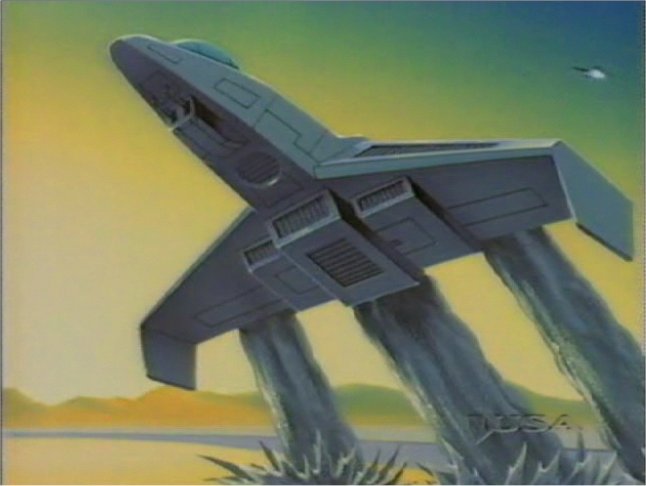
A Hellcat stands guard at the TCSF Flight School on Sirius.
The Hellcat V was a mid-war Terran Confederation medium fighter which served with distinction against the Kilrathi. Designed by the Garner Industries team and manufactured by Douglas Aerospace as a long-term replacement for the Wildcat interceptor, the Hellcat was best known as a workman's spacecraft. The fighter lacked the artist's panache of the Rapier II but instead enjoyed a life-long reputation as a particular sturdy, capable design. By the end of the war, the widely-deployed Hellcat was considered "the best all-around ship in the fleet." It should come as no surprise that an early model Hellcat has served as gate guardian at the Terran Confederation Space Forces Flight School at Sirius since the mid-50s.
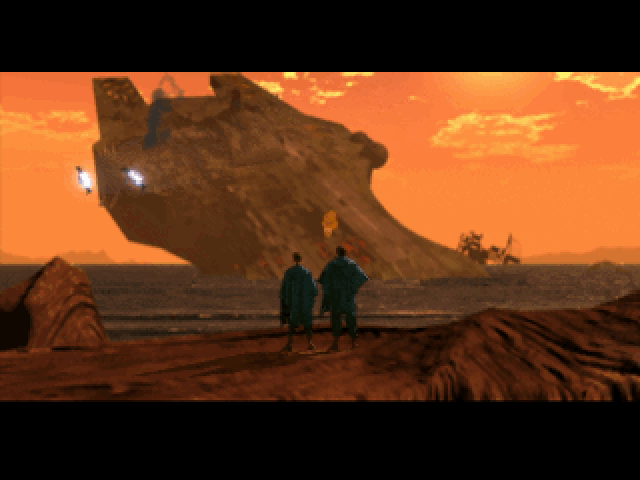
Hellcats identify the wreckage of the TCS Concordia.
Hellcats were generally deployed in point defense squadrons or outfitted for light attack missions. Later models were outfitted with increased fuel capacity for longer-duration escort missions, based on Hellcat tactics developed by Colonel Christopher Blair at Tamayo. Owing to an excellent aerodynamic profile, the reliable craft were also frequently assigned to air bases or tasked with space-to-ground missions.
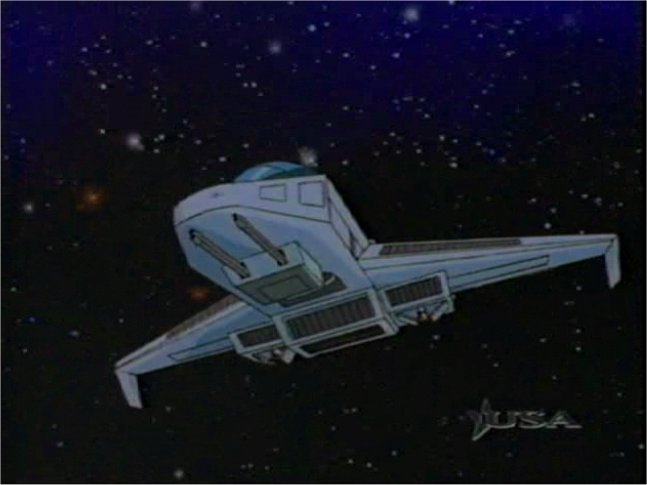
A simulated Hellcat trains future pilots about space combat.
The Hellcat's service history reads like the screen credits of a great supporting actor, taking part in many of the war's later campaigns but never truly taking center stage. The famed "Class of 54" trained for their first combat missions in Hellcat simulators on Sirius. A Hellcat squadron operated off the TCS Tiger's Claw with 58th FW during the closing months of the Vega Campaign, suffering losses during the fighting at Dolos. Later in the war, two of the 58ths surviving squadrons, the Killer Bee's and the elite Black Lions, would transition to the Hellcat. As the war progressed it was Hellcats that first located the wreckage of the TCS Concordia on Vespus, Hellcats that futily defended the TCS Coventry and Hellcats went in with the marines at Alcor.
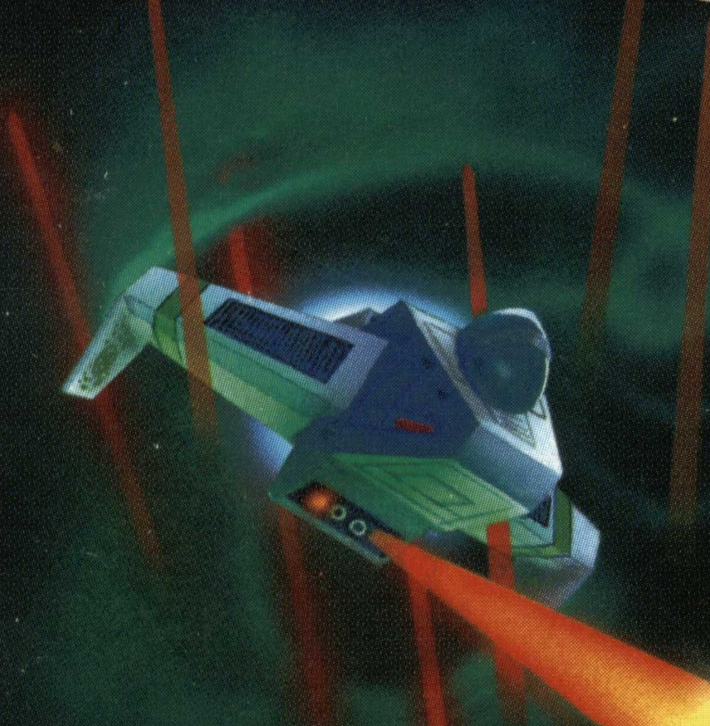
Hellcats had an excellent roll radius and throttle rate.
As the war raged on, the Space Force opted to consolidate medium squadrons with Hellcats rather than Epees or Rapier IIs. Pilots were given Hellcat transition training to fly the latest models. Christopher Blair and Jesse Dunlevy, who would both command the TCS Lexington's fighter wing after the war, attended transition training together. Noted squadrons operating Hellcats in the final months of the war included Dynamo Hum, Fire Birds, Gray Hornet, Great White, Osprey, Burma Tiger, Crazy Diamond, Red Ranger and Throat Wolves. Elite unites included Alphonzo's Raiders, Valkyrie and Zombie Wolf.
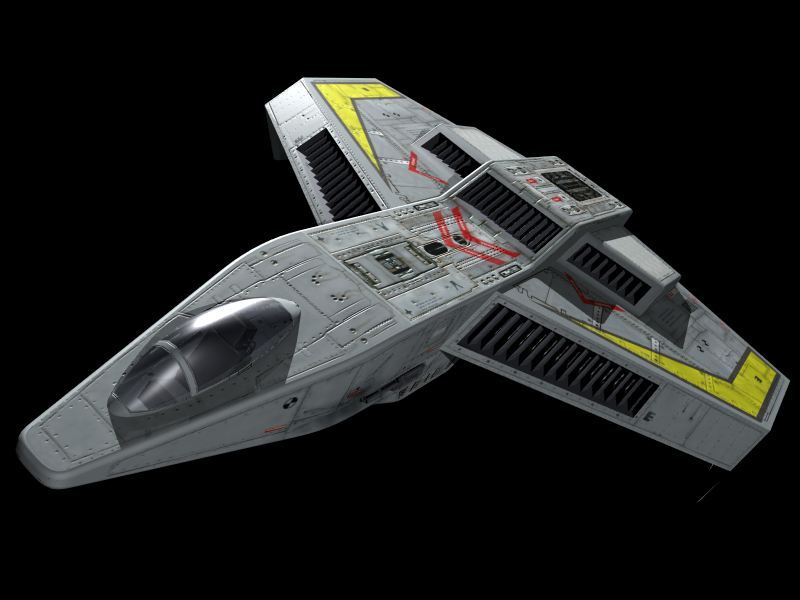
A post-war Hellcat off the TCS Lexington (CV-44)
Two Hellcat squadrons flew off TCS Victory during the war's final, darkest days in support of Colonel Blair's legendary Excaliburs as part of the 36th FW. Red Squadron served as point defense for the duration of Blair's assignment and White Squadron joined the carrier's complement during the run up to the Behemoth debacle. It was early on in his tour aboard the Victory that Blair decided to experiment with using his wing's short-range Hellcats to protect its more powerful Thunderbolt VIIs. Accompanied by a refueling shuttle for longer patrols, the interceptors thrived in this new role.

A Hellcat in the markings of the 36th Fighter Wing's Red Squadron.
One truly black mark on the Hellcat's service record was a famous incident in which a single Strakha stealth fighter was able to shoot down four Hellcats in ten minutes. The engagement became one of the most lopsided dogfights on record in the war's long history.
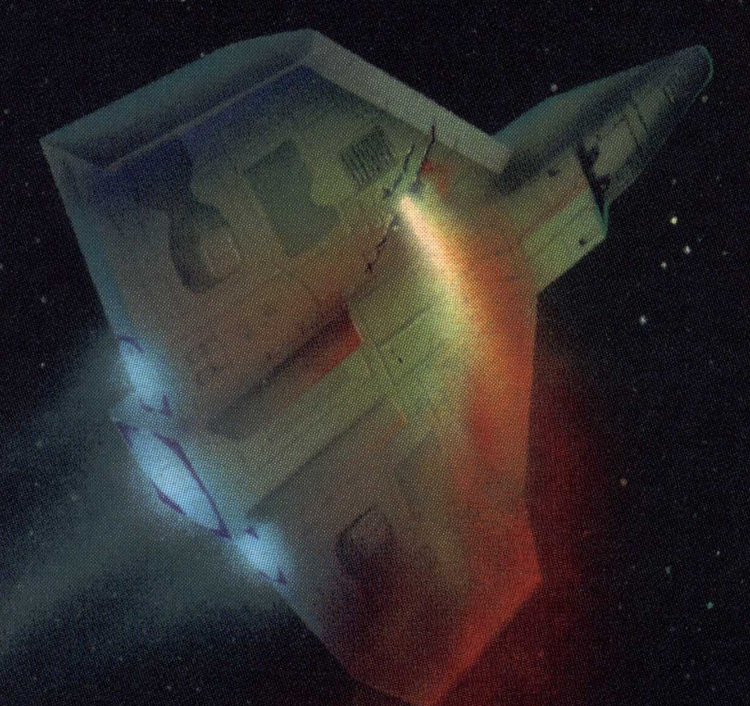
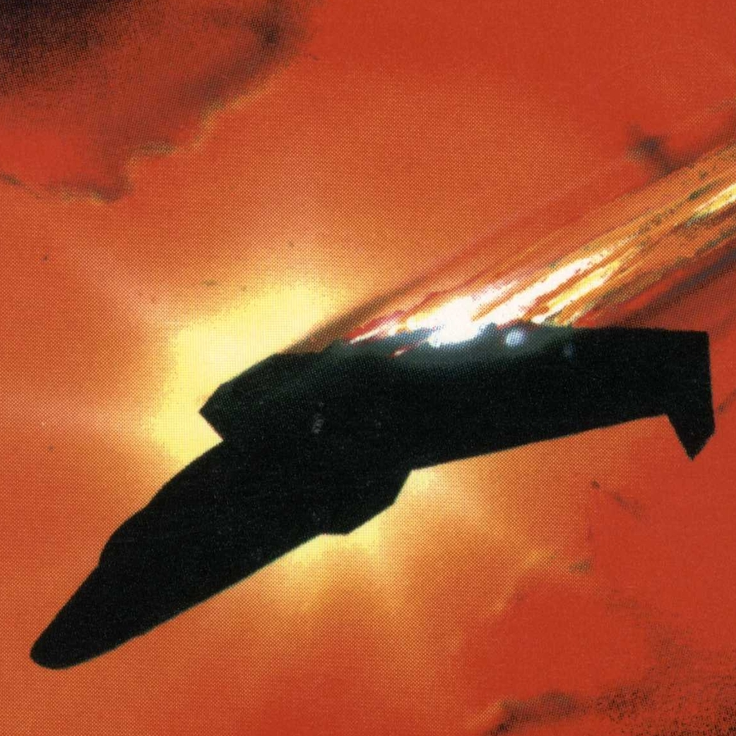

The Hellcat spaceframe was known for its ability to survive heavy damage.
The immediate post-war era saw a surge in Hellcat use, with longer range models escorting border convoys and front line squadrons re-equipped with factory fresh units. Recalled to active duty aboard the TCS Lexington, Colonel Christopher Blair again found himself in charge of a Hellcat unit. This time, he opted to fly a Hellcat himself, using the fighter in the abduction at Tyr and the capture of Masa. Multiple Hellcats off Lexington defected to the BWS Intrepid. Loyal Hellcats would battle Union Banshees at Circe and through the defense of the Vesuvius.
The early 70s brought about another black mark: The Project initially utilized Hellcats and Thunderbolts as technology testbeds which ultimately resulted a production run of "Black Hellcat" advanced technology demonstrators. The Hellcats, painted matte black, were the immediate predecessor to the Black Lance, and they served with cold distinction during the Border Worlds affair.
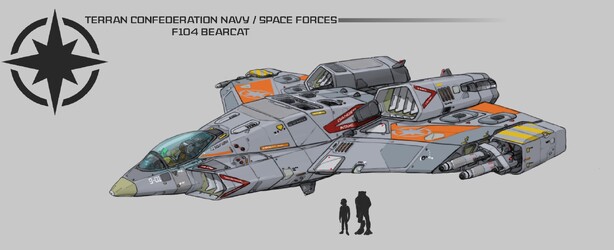
By the mid-2670s, the fleet refresh finally moved to retire the Hellcat. Two designs may claim a direct lineage: the impressive F-104 Bearcat, a dedicated space superiority fighter, and the sturdy F/A-105 Tigershark, which would ultimately replace the Hellcat in most front line units.
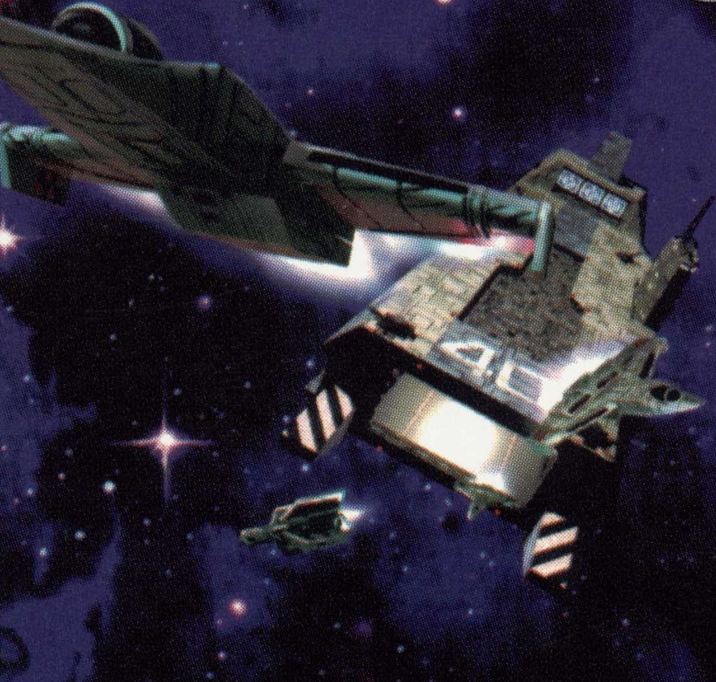
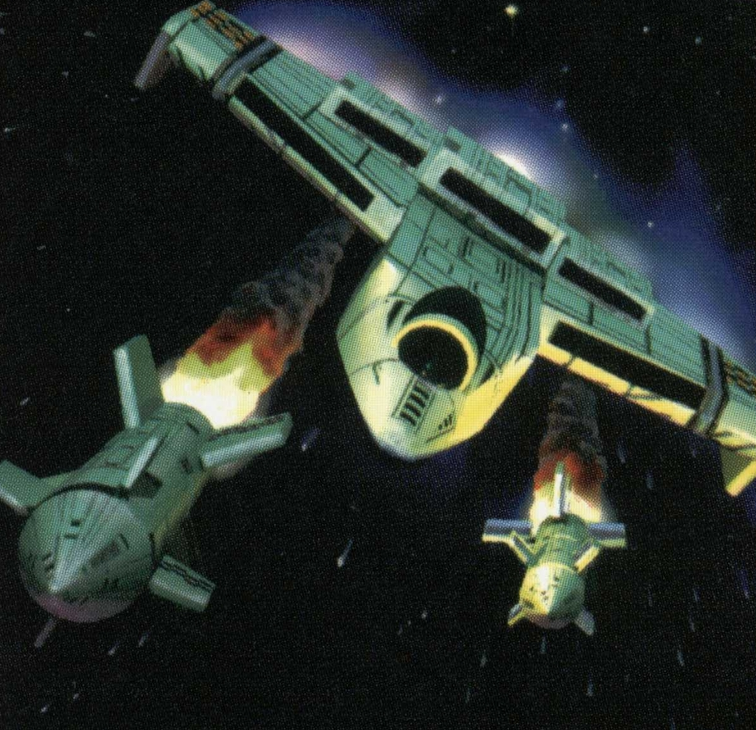
Hellcats fly point defense for a Yorktown-class light carrier.
Grumman began the XF6F project six months before the Japanese attack on Pearl Harbor. Originally designed to use the same engine as the F4F Wildcat, combat experience during the first few months of the war demonstrated the need to mount a more powerful engine to match the performance of the Zero. The entire aircraft was designed to accommodate the change to the larger engine. The Pratt & Whitney R-2800 Double Wasp engine provided 2,000 horsepower and excellent performance to the new F6F airframe. The R-2800 engine was also mounted in the wartime Republic P-47 Thunderbolt, Vought F4U Corsair and the postwar Grumman F7F Tigercat and F8F Bearcat.
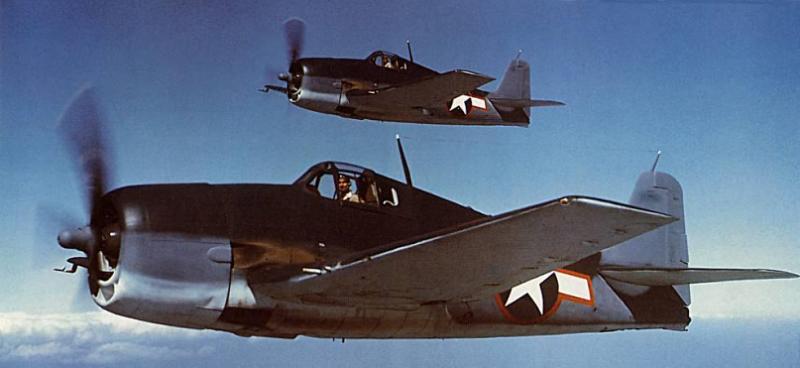
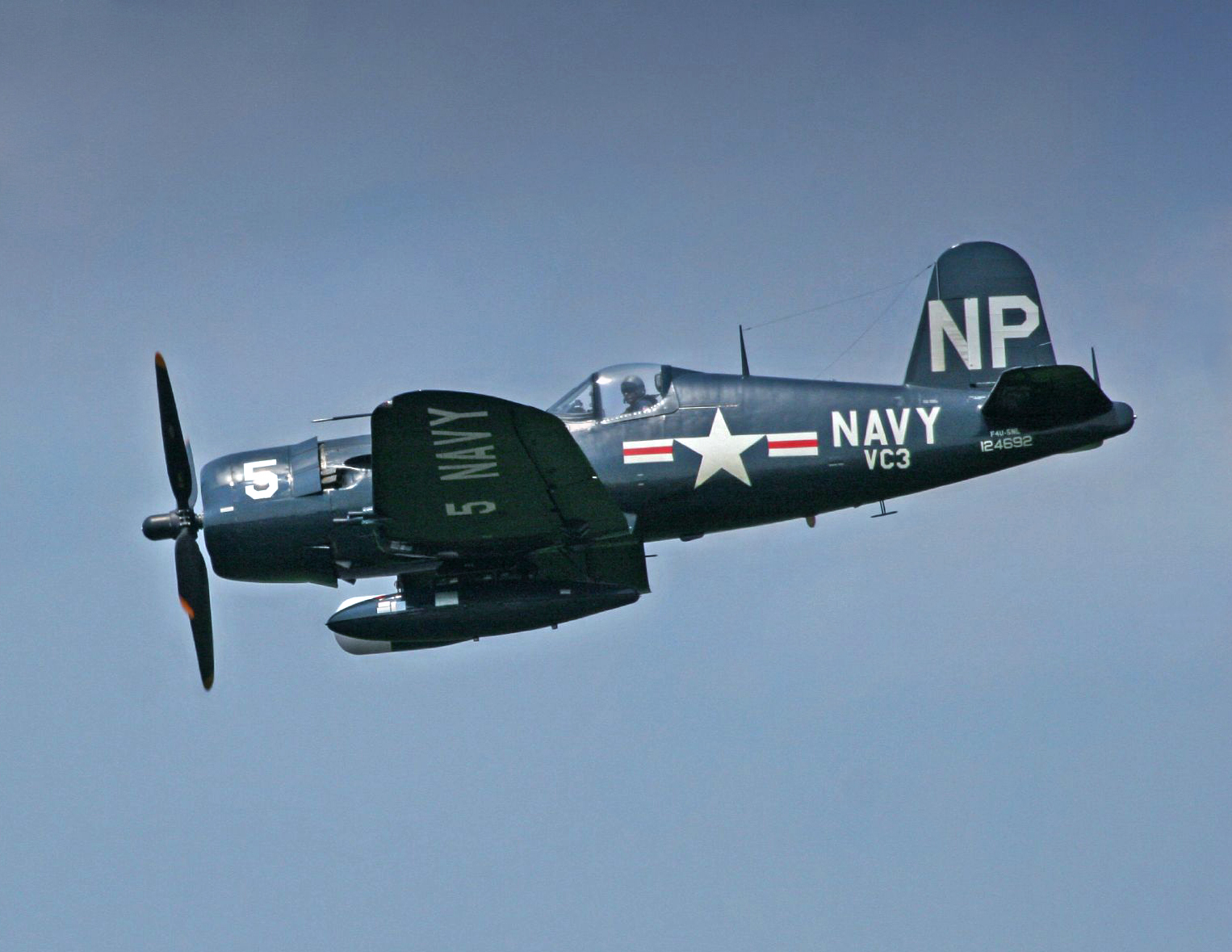
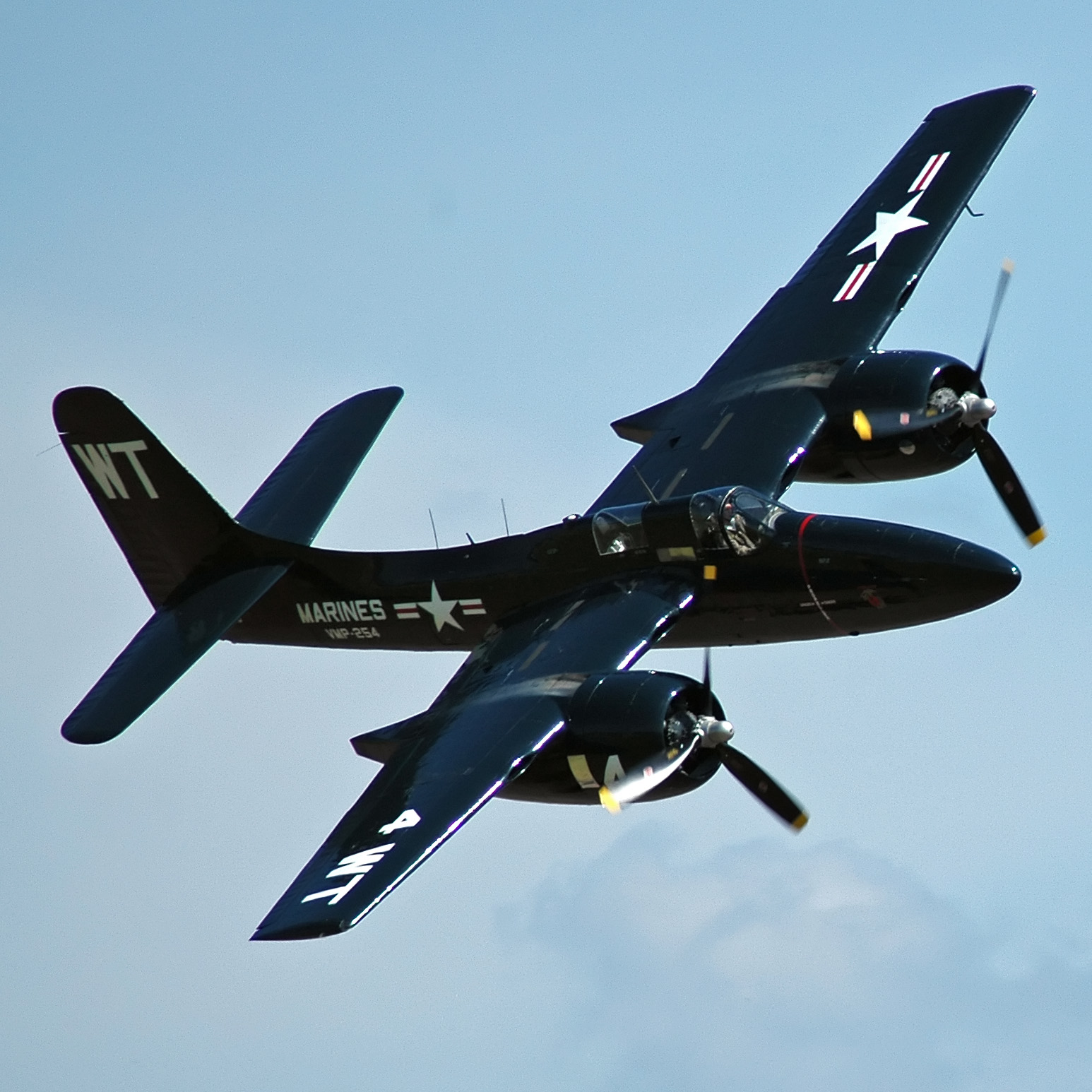
The F6F Hellcat and F4U Corsair both saw extensive service in World War II. The F7F Tigercat served as a night-fighter during the Korean Conflict of the 1950s.
While the F6F-3 Hellcat does share some visual similarity to its Wildcat sibling, the similarities end there. The Double Wasp engine provided more power which allowed the Hellcat to climb with the Zero. Many veteran Zero pilots would actually fall victim to this ability when the Hellcat was first introduced. Zero pilots mistook the Hellcats for Wildcats and would attempt to climb away, going vertical, from the American fighters in hopes of causing a stall, which the Wildcat was guaranteed to do in a vertical climbing maneuver against the Zero. The Hellcat could continue to climb against the Zero into a firing solution and then down the fighter with its six .50 caliber machine guns as the Zero dove down on what it thought would be a stalled Wildcat. The Hellcat had a significantly larger fuel capacity than the Wildcat giving the Hellcat almost double the combat radius of the Wildcat.
The F6F-3 Hellcat joined the Fleet in February 1943 when VF-9 became operational on the USS Essex (CV-9), the first of the new class of carriers, although Essex joined the Fleet after her sistership USS Yorktown (CV-10) because of the hard-driving skipper of the Yorktown, Captain J.J. “Jocko” Clark. The friendly rivalry between the two ships continued throughout the war. The Yorktown took the second, and perhaps more important, milestone on 31 August, 1943 when the first Hellcat launched from its deck on the new carriers first mission to raid Marcus Island. Marcus Island sits 2,700 miles west of Pearl Harbor. The new carriers and crews were the conduct their first combat mission against the lightly defended island in the early morning of the 31st. Task Force 15 was made up of the new carriers USS Essex (CV-9), USS Yorktown (CV-10), USS Independence (CVL-22), the new fast battleship USS Indiana (BB-58), two light cruisers, ten destroyers and a single fleet oiler. No aerial opposition was encountered by the Hellcats of Task Force that first day, although two Hellcats from VF-5 were lost to antiaircraft fire.
The next day, 1 September , Hellcat history was made near Baker Island when VF-6 pilot Lieutenant (jg) Richard L. Loesch made the first kill in a Hellcat when he downed a Kawanishi H8K “Emily” flying boat. He was also the first pilot to have scored while flying both of the Grumman “cats.” Loesch had made his first kill in a F4F Wildcat during the Battle of the Eastern Solomons in August 1942. The Emily was the first of 5,163 claimed kills by Navy and Marine Hellcat pilots. Throughout two years of combat service, Hellcat pilots earned the highest kill-to-loss ratio of any aircraft of World War II at an astonishing ratio of 19-to-1. 305 American pilots became aces flying the Hellcat, more than another American fighter during World War II.
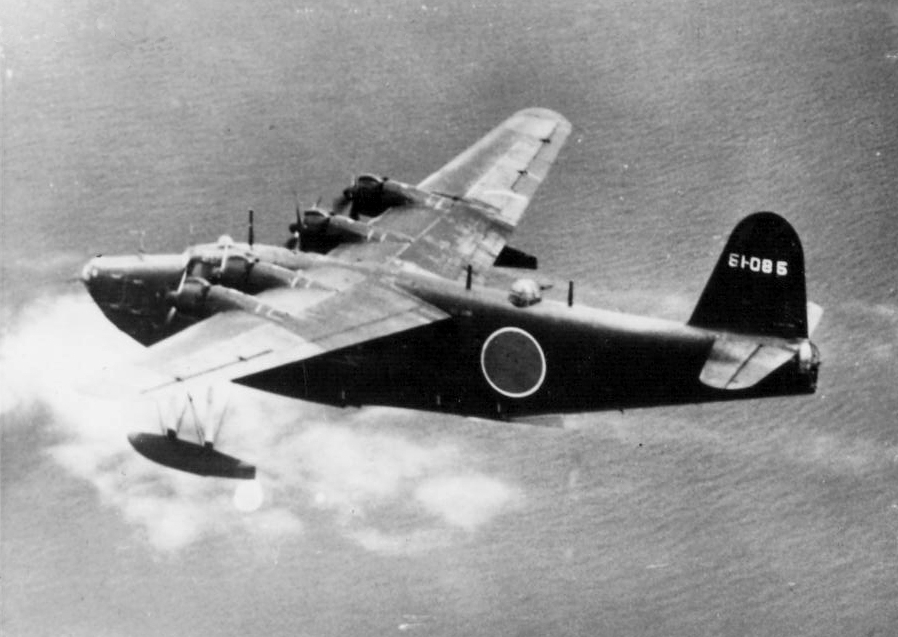
The first of more than 5,000 Hellcat kills was an Emily flying boat in the Central Pacific.
By the fall of 1943, every fleet and light carrier in the Pacific Fleet was stocked with F6F-3 Hellcats. Many of the land installations in the South Pacific had also received squadrons of Hellcats and Vought F4U Corsairs, which would be carrier ready until later in the war. On 5 November the veteran Saratoga (CV-3) and her new companion the light carrier USS Princeton (CVL-23) launched a single strike on the major Japanese base at Rabaul on the island of New Britain. 52 Hellcats escorted 45 Douglass SBD Dauntlesses and Grumman TBF Avengers to the targets resting in the harbor. Nearly 60 A6M Zeroes were in the air to meet the American strike. The Hellcats kept the Zeroes at bay as the SBDs and TBFs scored hits on six cruisers, heavily damaging three of them. Ten carrier planes were lost for roughly the same number of Zeroes. Less than a week later the Americans returned to raid Rabaul on 11 November, Armistice Day, with the three carriers of Admiral Montgomery’s Task Group 50.3.
The USS Essex, Bunker Hill (CV-17), and USS Independence launched 55 Hellcats and 46 Dauntlesses and Avengers on the morning of 11 November towards Rabaul. They were met by 68 Zeroes as they approached Rabaul. Five Japanese warships were hit during the raid including one destroyer sunk. As the carrier planes returned, the weather degraded and a follow up strike was cancelled. However, the Japanese had launched their own counterstrike against the American carriers. At 1350 Hellcats from VF-33 spotted the Japanese counterstrike 40 miles from the carriers. When the fighter controller stationed on the carrier asked for an estimate and was informed “There are millions of them!” In reality, there were 69 Zeroes, Nakajima B5N Kates, and Aichi D3A Vals from carrier squadrons transferred to Rabaul from their carriers stationed at Truk. 40 of the Japanese planes were shot down by Hellcats and land based Corsairs providing Combat Air Patrol (CAP). The American total for the day was roughly 50 kills for the loss of 18 aircraft. On 1 November there had been three Japanese air groups operational on Rabaul totaling 173 aircraft. Following the two American raids, 52 aircraft returned to Truk, almost all of them Zeroes.
The carrier groups of the Pacific Fleet were reorganized into Task Force 50 for Operation Galvanic, the invasion of the Gilbert island atolls of Makin and Tarawa. Six heavy and five light carriers formed the core of Task Force 50 and had 684 planes at their disposal. Every fighter in TF 50 was a Hellcat. On 23 November, the pilots of TF 50 finally made contact with Japanese aerial resistance. VF-16 pilot Ensign Ralph Hanks, got himself an impressive bag. Ensign Hanks was the first Hellcat pilot to become an “ace-in-a-day” by destroying five enemy aircraft in a single day’s work, in his case a single sortie. More than 40 Hellcat pilots became an “ace-in-a-day” in the next two years. The first Hellcat ace was Lt. Hamilton McWhorter, who earned the distinction on 18 November, 1943 after downing a Japanese flying boat near Tarawa.
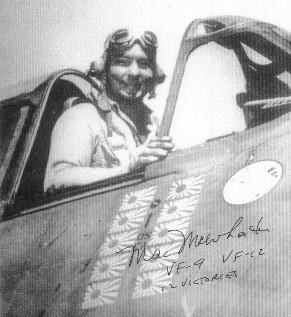
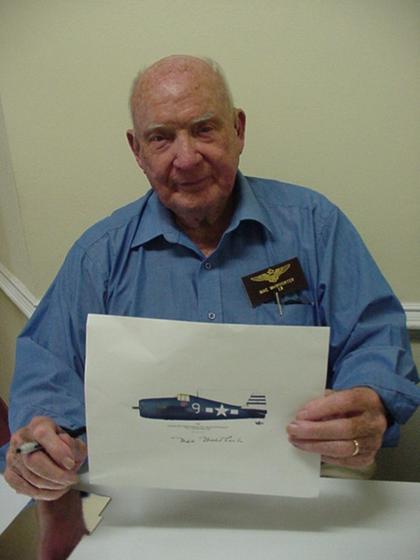
Lt. Hamilton McWhorter of VF-9 became the first Hellcat ace in November 1943. He was the first of more than 300 pilots who became aces in the F6F. He finished the war with 12 kills and the rank of Commander. He passed away in 2008.
During Operation Galvanic, not only did Hellcats provide daytime CAP, there was also a push to develop night fighter tactics to counter Japanese dusk and night torpedo attacks. Lieutenant Commander Edward Henry “Butch” O’Hare, flying an F6F Hellcat along with a wingman in another Hellcat and a TBF Avenger, conducted the Navy’s first ever nighttime fighter mission on 26 November. In a confusing first mission, the three planes had difficulty locating enemy targets until they stumbled upon a Mitsubishi G4M Betty bomber. In the ensuing melee O’Hare’s Hellcat was hit and he was lost. For fifty-four years who had shot down O’Hare remained a mystery. In 1997, historians Steve Ewing and John Lundstrom clearly state that the Japanese guns, and not friendly fire, took down one of America’s first heroes of the Pacific War. In the first months of the war, Butch O’Hare had single-handedly destroyed five G4M Bettys as they sought to strike the USS Lexington (CV-2). For his action, O’Hare received the Medal of Honor from President Roosevelt later in 1942. He had volunteered to return to flight duty and to lead the “Bat teams.” His loss was a great blow to the American naval aviation community.
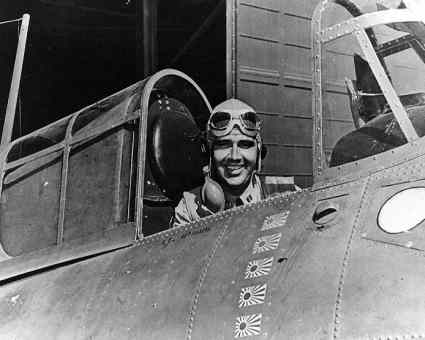

Lt. Commander Edward "Butch" O'Hare sitting in his F4F Wildcat early in the war. He was awarded the Medal of Honor for his actions near Rabaul in the spring of 1942 when he singlehandedly destroyed five incoming G4M Betty bombers.
Over the Marshalls atolls, the fortresses at Truk and Rabaul, New Guinea, the Admiralties and others, the Hellcat performed above expectations. Time after time, Hellcats rose to meet their Japanese adversary and were able to best them using their aircraft’s superior performance and their additional training. Task Force 50 eventually evolved into Task Force 58, commanded by Admiral Marc “Pete” Mitscher, an early naval aviator, and comprised of fifteen carriers carrying almost a thousand aircraft, including more than 450 Hellcats by June 1944. The fast carriers had spent the previous year wisely and had developed new doctrine and tactics to best utilize their strength. Early morning “fighter sweeps” had been developed to suppress Japanese aerial defenses before they had a chance to get off the ground by launching a pure fighter force (at first exclusively Hellcats, but later the F4U Corsair would also be used) against Japanese airfields. In June 1944, the Fifth Fleet, led by Admiral Raymond Spurance, and spearheaded by Task Force 58, launched Operation Forager, the invasion of the Marianas islands of Sapain, Guam and Tinian. The Americans were not only seeking to secure the islands for future operations, Admiral Chester Nimitz, commander of the Pacific Fleet, sought to provoke a fleet engagement with the Imperial Japanese Navy’s Mobile Fleet. Prior to the invasion Nimitz said: “I don’t know anything more we can do to provoke these people into a fleet action.”
The invasion of the Marianas did send the Japanese fleet into motion. The Japanese High Command activated Operation A-Go in early June. The plan called for the Mobile Fleet, commanded by Admiral Ozawa Jisaburo, uniting the carriers and battleships of the Imperial Navy to strike towards the American forces attacking the Marianas from the west after transiting the Philippine Sea. Using the superior range of their aircraft, the Japanese hoped to “shuttle bomb” the American forces using the airfields on Guam, Rota and Tinian. Japanese planes would launch from their carriers, attack the American ships, land on the nearby airfields to rearm and refuel and then launch again against the American fleet on the return to their carriers. This plan was disrupted from the beginning when the Americans destroyed most of the planes stationed in the Marianas in the first fighter sweeps.
Clark Reynolds, the famous fast carrier historian wrote of the American naval strength:
The United States Fifth Fleet in June 1944 comprised the most powerful battle fleet the world had ever known…Task Force 58 included fifteen fast carriers (seven heavy and eight light)..the Battle Line could form no less than seven new fast battleships. Three heavy and seven light cruisers and sixty destroyers made up the rest of TF 58’s strength. The fifteen fast carriers carried 902 aircraft, 452 of which were F6F Hellcats.
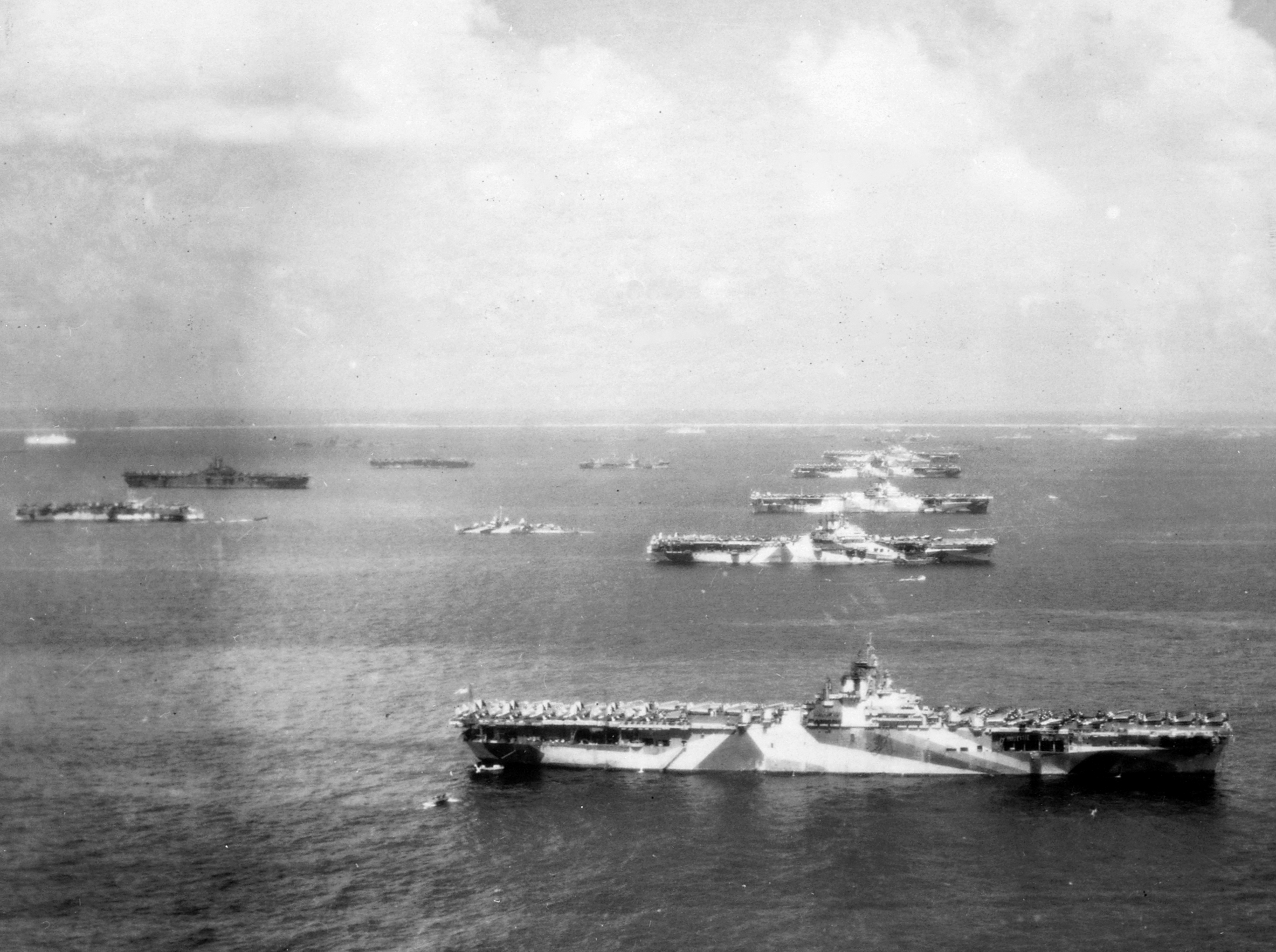
The Fifth Fleet was the most powerful naval force in the world. Here fast carriers and battleships of Task Force 58 sit at anchor awaiting their next assignment.
The Mobile Fleet carried 450 operational aircraft. There were more Hellcats in Task Force 58 than the Japanese had in total onboard their nine carriers! The pilots of the Mobile Fleet were far from the experts of Kido Butai at the start of the war. Most had barely 100 hours of rudimentary training in their various flying and combat roles. By comparison, the average American pilot had two years of training and 500 flight hours before they were even considered for deployment to the fast carriers.
Ozawa launched four raids towards Task Force 58 on 19 June. 373 planes were sent against the Americans. 322 were destroyed by intercepting Hellcats and AA from the ships of the task force. It was an aerial slaughter not seen before. A pilot on the USS Lexington (CV-16) was overheard following one of the raids “This is just like an old time turkey shoot back home.” The Great Marianas Turkey Shoot was born. The Hellcats tore the heart out of what was left of Japanese naval aviation. The Japanese had spent two years rebuilding their carrier strength only to see it destroyed in a single day. Lt. Alex Vraciu was famously captured (and shown in a previous update) on film holding up six fingers, one for each kill he’d scored that day. There were numerous pilots with high kill scores that day.
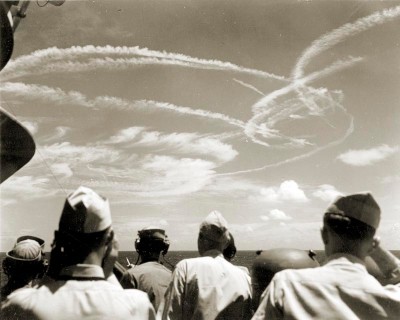
Sailors onboard one of the American carriers watching the "Great Marianas Turkey Shoot" unfold in the skies above them, 19 June 1944.
Throughout the rest of the war the Hellcat would be little improved until April 1944 with the introduction of the F6F-5. Later F6F-5 variants mounted four .50 caliber machine guns and 20 mm cannons. The two cannons provided additional firepower that proved extremely useful against the dreaded Kamikazes. The F6F-5 also allowed the mounting of wing rockets for additional firepower beyond the 2,000 lbs bomb load of the Hellcat.
On 15 August, two strikes were sent to raid Tokyo when at 0635 the carriers came on the air and broadcast:
All Strike Able planes, this is Nitrate Base. All Strike Able planes return to base immediately. Do not attack target. The war is over.
The last dogfight of World War II happened as the American planes returned to their carriers. Lieutenant (jg) M. Proctor of VF-9 shot down two fighters before he destroyed a Nakajima Ki-84 Frank as he made his way to his carrier. This was the last air-to-air kill of World War II, and it was completed by a Hellcat.
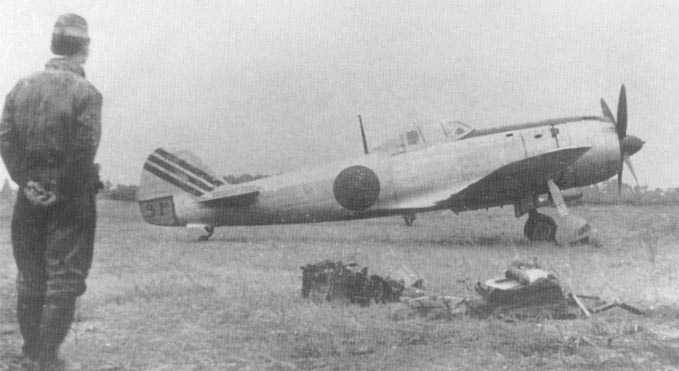
The last Hellcat kill of World War II was a Ki-84 Frank, like the one pictured above.
The last Hellcat left the Grumman “Iron Works” factory in Long Island, so named because of the ruggedness of Grumman aircraft throughout the war, in November 1945. 12,275 Hellcats had been built, with more than 11,000 of them being built between September 1942 and September 1945. Hellcat pilots in the Pacific and European theaters were credited with a total of 5,216 Axis aircraft in exchange for 270 Hellcats lost in air combat in that twenty-four month period, for an unprecedented kill-to-loss ratio of 19-to-1. A more impressive stat is presented by Barret Tillman who notes:
The Hellcat proved to be a superb bomber escort – something more often attributed to the Army Air Force’s P-51 Mustang. But official Navy records show that from 1943 to 1945, only 42 U.S. carrier-based dive bombers or torpedo planes were known lost to Japanese aircraft.For obvious reasons, fighter pilots weren’t the only people who loved Hellcats.





Follow or Contact Us