
Are You Not Computer Entertained?


The Video Game History Foundation recently announced that they had acquired the rights to Computer Entertainer magazine, a gaming periodical that ran from 1982 to 1990, and made it freely available online under the Creative Commons license. This is an invaluable resource for early gaming historians… but the magazine ended its run in July 1990, two months before the original Wing Commander was released. Nevertheless, Danthrax (amazing Wing Commander Armada reference!) discovered two pretty interesting articles that are relevant to our interests!
The first article is from Computer Entertainer's penultimate issue, June 1990. It's short but it covers a very important point in history: the initial announcement that Origin will show off a space sim named 'Squadron' at the upcoming summer CES trade show.
Origin has two new programs to show at CES
First in series of Ultima spin-offs plus space combat simulation
Origin will launch a new series of Ultima spin-off games at CES with the first showing of VALLEY OF THE DINOSAURS (tentative title), planned for a fall release for MS-DOS systems. The series will be known as "Worlds of Ultima" and will use the Ultima play style with adventures in new worlds outside Britannia and the medieval tradition of the Ultima series. VALLEY OF THE DINOSAURS takes place in a pocket within the jungles of Brazil that was caught in a time warp when a Moonstone crashed there in ancient times. The player is sent by Lord British to this place where dinosaurs still roam and charged with the task of recovering the Moonstone. The player's antagonist is a modern-day evil character who has a machine which can create Moongates from Moonstones. Origin's second MS-DOS title to be shown at CES is Chris Roberts' SQUADRON (tentative title), a space combat simulation. The game is planned for fall release and features digitized video images rendered with scaled bit-map graphics.
The second article appears in the magazine's final issue, July 1990, and it is even more interesting. It's part of a report from CES which saw Squadron, now named Wingleader, for the very first time in the form of the game's rolling demo. Wing Commander was shown to the public for the first time alongside the first Worlds of Ultima game, Savage Empire. Oh, to go back in time and see that all unfold!
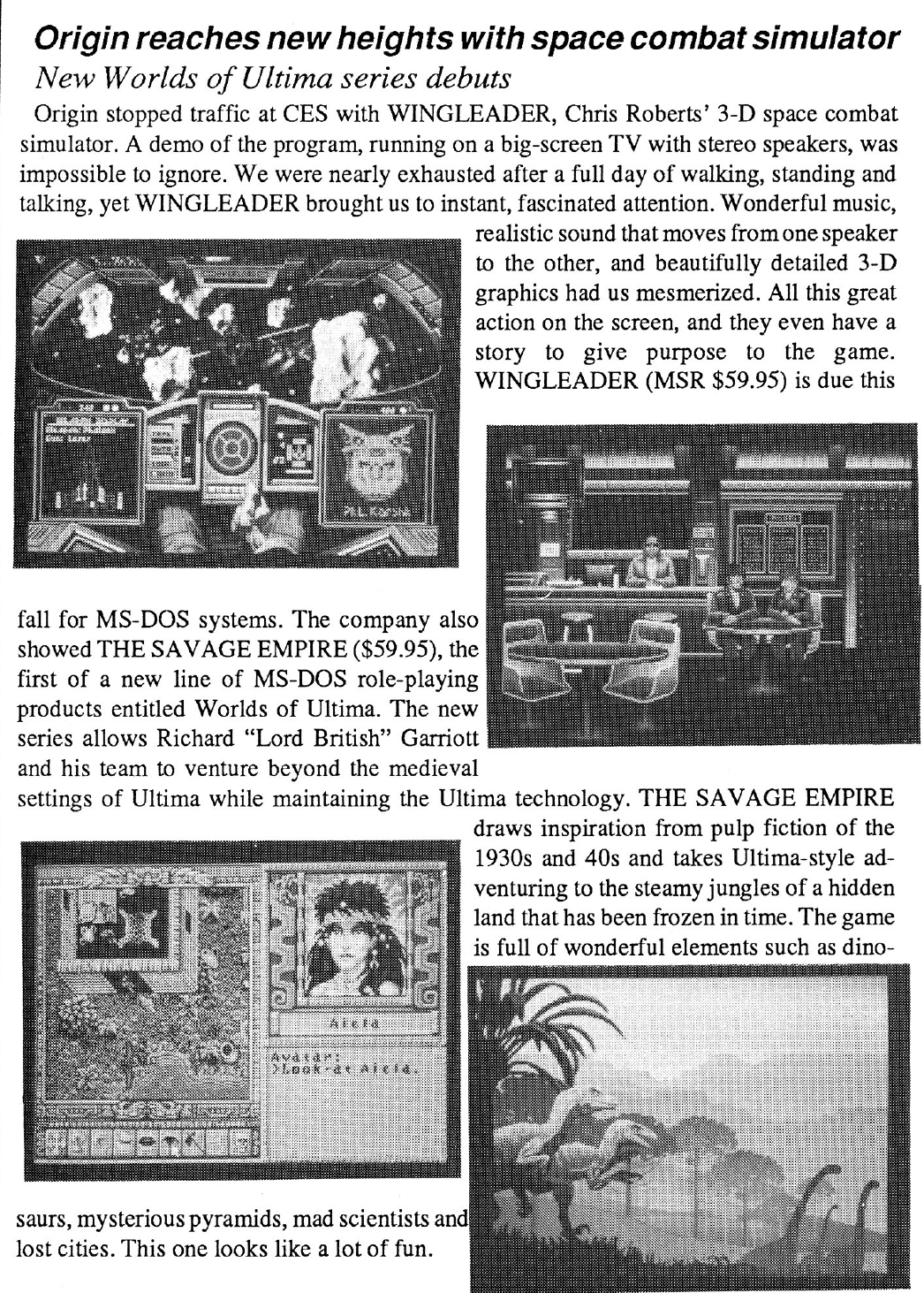
Origin reaches new heights with space combat simulator
New Worlds of Ultima series debuts
Origin stopped traffic at CES with WINGLEADER, Chris Roberts' 3-D space combat simulator. A demo of the program, running on a big-screen TV with stereo speakers, was impossible to ignore. We were nearly exhausted after a full day of walking, standing and talking, yet WINGLEADER brought us to instant, fascinated attention. Wonderful music, realistic sound that moves from one speaker to the other, and beautifully detailed 3-D graphics had us mesmerized. All this great action on the screen, and they even have a story to give purpose to the game. WINGLEADER (MSR $59.95) is due this fall for MS-DOS systems. The company also showed THE SAVAGE EMPIRE ($59.95), the first of a new line of MS-DOS role-playing products entitled Worlds of Ultima. The new series allows Richard "Lord British" Garriott and his team to venture beyond the medieval settings of Ultima while maintaining the Ultima technology. THE SAVAGE EMPIRE draws inspiration from pulp fiction of the 1930s and 40s and takes Ultima-style adventuring to the steamy jungles of a hidden land that has been frozen in time. The game is full of wonderful elements such as dinosaurs, mysterious pyramids, mad scientists and lost cities. This one looks like a lot of fun.
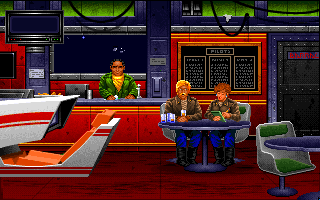
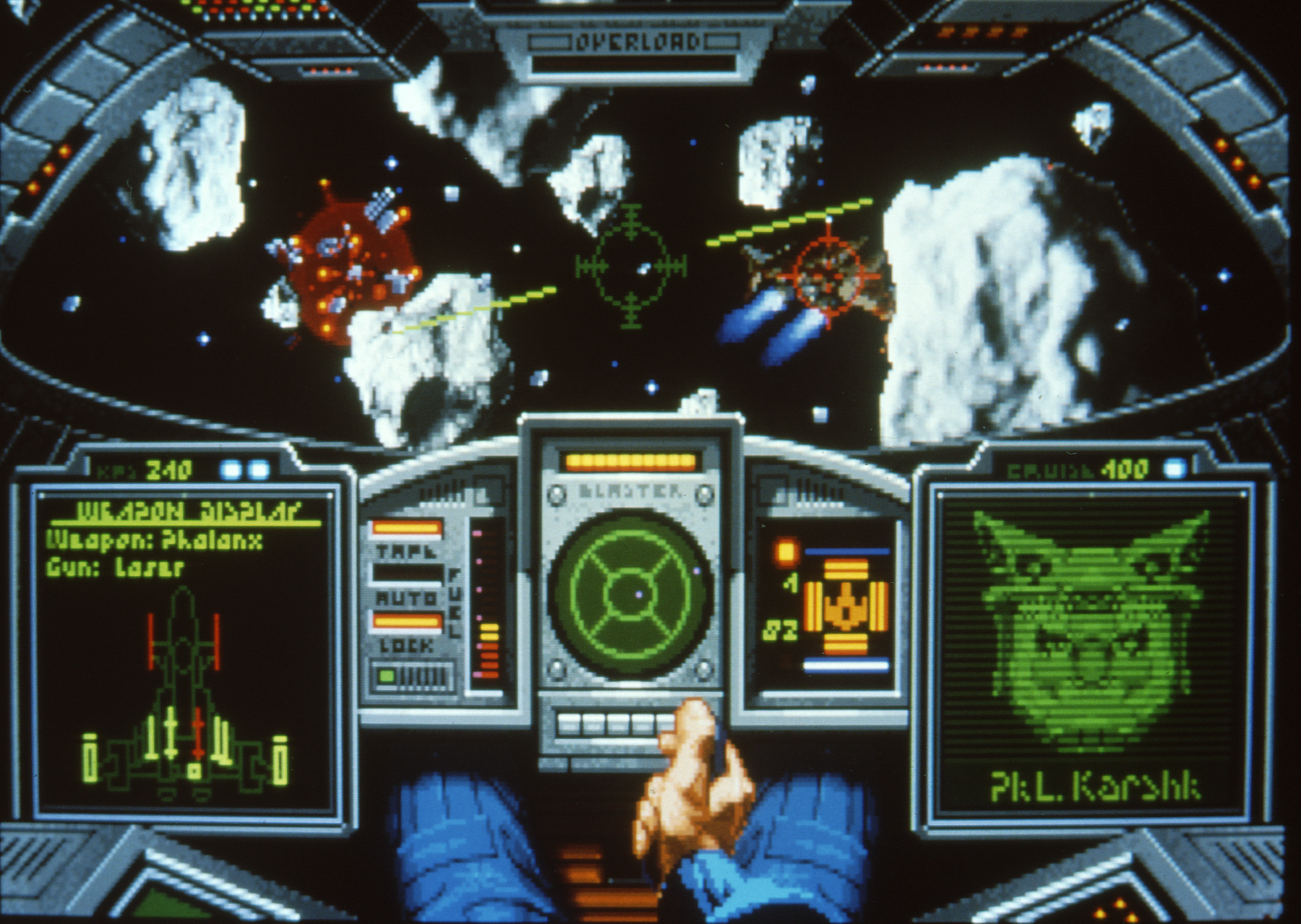
It also includes two screenshots from the game's press kit. One of which is a cockpit shot has been seen frequently and was included on the game's box… while the other is more of a rarity! It shows an earlier version of the Tiger's Claw rec room options screen, seemingly before the decision to include a TrainSim was made. In addition to a prominent second table, moved to the right in the final, there are some other neat differences. The pilots don't yet have their props, the top of the screen doesn't have weathering and loose cables and the Tiger's Claw bar ends up completely losing its stools! There's also no mission with Hunter and Angel together as the talking heads.
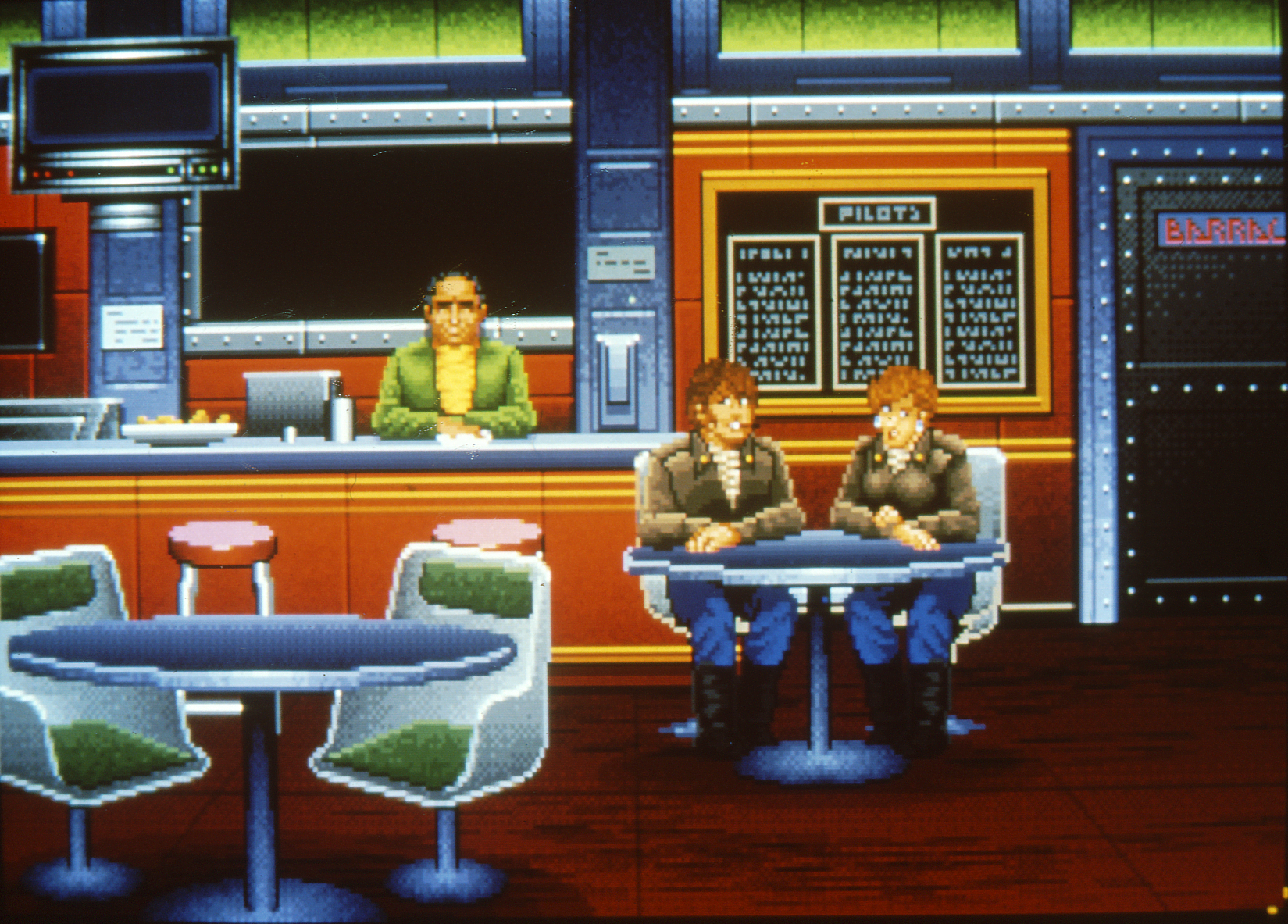
Both of these images are 'bullshots' which were created by artist Denis Loubet using Deluxe Paint around June 1990 to help launch the game's promotion. They would've been provided to the press in the form of 35mm slides. They are constructed out of in development art assets arranged to show how it was hoped the game would function in its final form. This allowed for the images to have higher resolution elements than the final product. That's also why these and the screenshots on the box feel slightly off; they're just a very good mockup of a game that happened to come extremely close to the creator's initial vision! You can read more about the original game's bullshots here.
Would you like to watch the rolling demo that wowed the gaming press that summer? Here's a recording courtesy of DOS Nostalgia:
What's the deal with the change in the game's name from month to month? Here's the story of the two name changes and the CES demo from the Wing Commander I & II Ultimate Strategy Guide:
At almost every software company, the working title of a game under development changes by the time it's released. With the show right around the comer, everyone wanted to nail down a name right away. Trademark searches blew away any possibility of using the name Squadron, and after numerous meetings, Wingleader was selected.
Everyone in the company understood the importance of trade shows, but few were thrilled by the prospect of producing the items that make them successful. For the creative services department, the CES show meant that the box art had to be completed three months before the release of the game. They sure didn't want to incur the costs or the time involved in repeating the task a few months later. For the art department, the show required quality grapfiics for the demo that would, in all likelihood, never be used in the shipped version of the game. From a sound and music standpoint, the demo demanded editing work for narration, and transitional music that wouldn't match what was created for the final version. For the producer and director, it meant pulling resources away from the actual completion of the game to develop the self-running computer demo. . . a scheduling nightmare. For Chris Roberts, it meant a solid week of 18- to 20-hour days to finish the programming and assembly.
Needless to say, the CES show was a resounding success for Origin. The Wingleader demo surprised people in every corner of the industry who had thought of the company as the mecca of fantasy and role-playing software. It seemed to many that this action-adventure simulation had come right out of left field. Actually, it was a blast from home plate that the left-fielder never had a chance to reach. It was a monumental home run.
To Marten Davies, Vice President of Sales, the show was an unqualified success and produced the tool he needed to keep excitement at a fever pitch. "I kicked hard to have a demo completed for the show," he said. "It was just a gut reaction, but I knew I needed to flood the retail and distribution channels with he demo. Before the release of the game, I wanted the excitement to grow so that the confidence level would be extremely high. If we could get consumers beating a path in and out of the door, asking whether the game was out, distribution would respond."
While the demo disks produced for the trade show gave people the impression that Wingleader was a game, it was actually just a naked, arcadish simulation at that point in development. For the show, Chris had the playtesters fly around while he recorded it. Then he had the artists work on some special graphics while he coded the flying sequences in the demo. George wrote the text and picked out the order of the shots and Roberts fine-tuned it for the show. Now it was time to turn it into a game.
A high excitement level wasn't the only result of the trade show. In meetings with distributors. Origin had promised a September release of the game. The date was based on estimates from product development, but the deadline was now etched in stone and Chris, Jeff, Warren, and the rest of the team had to deliver.
From Wingleader to Wing Commander
A surprise awaited everyone at the end of the show. While the initial trademark search had cleared Wingleader, there were enough similar names of early software titles, MicroProse's Wingman among them, that the company yielded to its second choice, which had come through the search unscathed. Wingleader became Wing Commander, and with that final selection and the September deadline, the intensity moved to warp speed.
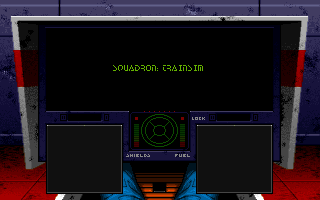
The Fatman also recently shared his memories of working on the CES demo. The legal issues have been resolved by the 27th century… if you leave the TrainSim to sit in the original game you'll find it's named Squadron!



Follow or Contact Us