Oct 20 correct date?
I know the Sivar-Eshrad is once a year, but did anyone compensate for the fact that its "once a kilrathi year" and that the kilrathi year is LONGER than the terran year.
The quick and dirty way
As per wcrevival.de ---
Q: Sivar Eshrad always in .293?
A: The problem occuring to us during the work on the WC Academy series was "When does Sivar Eshrad take place in 2654". We asked ourselves that since the Kilrathi calendar seemed to be different from ours. So one Kilrathi year wouldn't be as long as a Terran year and resulting: Sivar Eshrad doesn't take place on the same Terran day every year. But the solution came to us in a dissapointing way. It DOES take place on the same day since Origin didn't use a complete Kilrathi calendar (as we thought to have seen in the WC Armada Manual) but simply calculated the decimal-system Terran dates into octal-system numbers to make it appear Kilrathi. But fact is.. A Kilrathi year is still 365 days long, but 365 written octal is 555, so it appears that a Kilrathi year has 555 days. Yes, octal written days, which are still 365 decimal days. So the Kilrathi use exactly the same numbers and have the same lenght of day, month and year as we here on Earth. They just write it different.
As dissapointing this was in a way, it made it at least easier for us to find out when Sivar Eshrad took place in 2654: on the same day as in 2655 and later.
MY NOTES ON THIS METHOD: WC Armada manual confirms this method. While easy, I find it highly unlikely since the chance of the Kilrathi year being nearly identical (to within a few minutes) as the Terran year. Only the one game uses this method/reference type.
RATING
Accuracy: 10/10 (if you assume "1 kilrathi year = 1 terran year")
Explanation: 7/10
Uniqueness: Rare (based from one explanation which is only used in one game)
[The semi-mathematical web-search way]
As per WC species database at
http://hkn.eecs.berkeley.edu/~drake/govt.html
The Eshrad is on the 640th day of each Kilrathi year.
Kilrah's relatively close proximity to its sun with relation to Earth/Terra makes a Kilrah day approximately 10.5 Earth standard hours long. One Kilrathi standard year is about 669 Kilrathi standard days long, with one leap year of 668 days occurring every three years.
If this was true, then the Eshrad would be once every second Terran year. 1 year and 303 days... or roughly 1 year 9.77 months, which works out to 1 year 9 months 23.9999 days (bout 40 seconds short of 24 days)
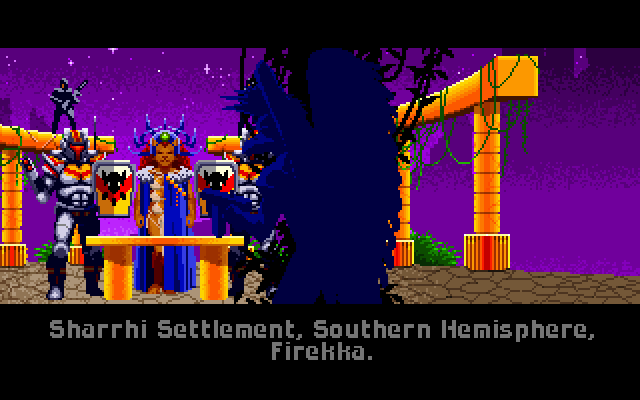
MY NOTES ON THIS METHOD: You would need to calculate and recalculate every Eshrad starting at the from the one witnessed (on Ghorah Khar on 2621.293). This site uses the same history/profile/database as WC-CIC, which has the Eshrad on Firekka starting 2655.293 (confirming a start of .293 aka Oct.20) but the Terran-marine-assisted Firekkan resistance running until .315 aka Nov.15 before the Kilrathi gave up,
which suggests the Eshrad lasts about 25 days (or that there's some kind of "time limit" like maybe a lunar cycle) within which that the Eshrad must be completed.
Laughs. The site uses a "1.83" earth years per kilrathi year on their main species info page, but then when you click the links they send you to the larger "Kilrathi Comprehendrum" which WC-CIC and many others use, which has the Kilrathi year at 1.2 Terran years (438 days, not 669 days).
RATING
Accuracy: 6/10
Explanation: 7/10
Uniqueness: Fair but incomplete and inaccurate ... they reference two different Eshrads but then give the same day of the year (Oct. aka year# point 293) for both. That's imposible considering the 1.8 : 1 ratio would mean that the year before it would be in March and the one after would be in June)
The WC CIC Kilrathi database method
The standard Kilrathi year, 1.2 times as long as the Terran Standard. They are divided into 545 "orbits."
RATING
Accuracy: 3/10
Explanation: 3/10
Uniqueness: Fairly common to WC sites as they quote WC CIC or the CIC Kilrathi Comprehendrum as their info source.
The LONG math method
-- my prefered way --
Using WC-CIC as a basis...
This puts the Kilrathi year at 438 days, so you can use the 293'rd day of each of their years. And because their year nicely works out at 1.2 Terran, that means you'd see a date loop of 5 (approximately). (by "date" loop I mean the you'll get about 5 Eshrads in a row before you get a kind of "loop year" where a given Terran-year-# won't have an Eshrad during it.
I.E. the "day" changes. Say for 2009 the Eshrad falls on 2009-Oct-20, that means the next one is
1 year 73 days later... so it goes forward and backward like this:
2003-Sept-20
2004-December-2
2005 - is a "leap year" since there's no Eshrad during it
2006-Febuary-12
2007-April-26
2008-July-8
2009-October-20
2010 - is a "leap year" since there's no Eshrad during it
2011-January-1
2012-March-15
2013-June-27
2014-September-8
2015-December-20
2016 - is a "leap year" since there's no Eshrad during it
2017-March-3
2018-June-15
Course though, you shouldn't be starting in the present and working forward but starting on either the WC1-SM2 Eshrad on Firekka since its date is probably the most accurate (2655.278 -2655.315 for SM2 with the "exact" Eshrad date of 2655.293)
The Dolos Eshrad in WC Academy cartoon doesn't really have a date given, though many have "assumed" or "guestimated" it using the first-method's "point 293 rule". Unfortunately too many forget that the "point 293 rule" isn't 100% right cause it's the 293rd day of the KILRATHI year, not the Terran year.
Using the Firekkan date, 2655.293, aka 2655 Oct 20, then using my sample Eshrad list, you can somewhat work out what month it'll be for 2009. (Oct.20 2055 would probably work out at roughly 600 Eshrads before Firekka... seems every 6th year it falls on a 20th, so 6x100 = 600, so 2655.293 - 600 = 2055.293).
From there working back I get 2009.Jan.1 as the 2009 Sivar-Eshrad and 2000.Sept.8 as the y2k Sivar-Eshrad.
RATING
Accuracy: 7/10
Explanation: 7/10
Uniqueness: Fair but incomplete and inaccurate ... they reference two different Eshrads but then give the same day of the year (Oct. aka year# point 293) for both. That's imposible considering the 1.8 : 1 ratio would mean that the year before it would be in March and the one after would be in June)