Win By Losing (January 11, 2010)

ChrisReid

Super Soaker Collector / Administrator
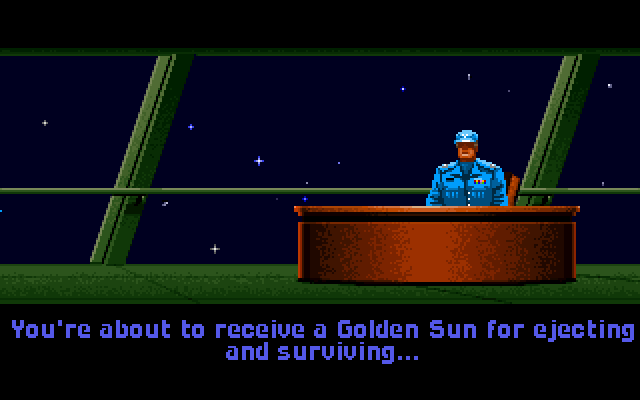
Game Central has posted a review titled Wing Commander and the Awesomeness of the Epic Fail on the branching mission trees of classic WC games. There's a lot to be said for modern sandbox and open-ended games that were kicked off by Elite and Privateer, but mission-based games do seem to be quite a bit more linear these days. Either way, the author nails it at the end - Wing Commander is definitely a game everyone loves to come back to! Thanks to Jonathan Strawn.

Since the game isn’t dependent on victory, the goal of winning out the war is subverted to the goal of simply surviving long enough to see it through. This difference is the axis upon which the emotionality and depth of the game can turn in unexpected directions. As long as I come back alive, I have to face the consequences of my performance. Those consequences build up over time. Fail a few times and the missions turn more defensive. A few more, and I’m scrabbling to turn the tide of the war. String enough failures together, and now I’m covering a hasty retreat from the sector– alone, if my would-have-been wingman already bought it in a furball a few missions back.
...
If failure adds to the quantity of gameplay, it also adds new qualities to the characters. In the ship’s lounge, my crew mates reflect on their experiences of the war. I see different aspects of the same characters emerge as victory nears or defeat looms. The lounge becomes a profoundly affecting place upon discovering an vacant seat where a wingman would have sat, had he or she not died in a prior mission. Since wingmen can usually die only when they fly with me, the emptiness becomes personally significant: I know the cost of my failure, but I am rewarded with a richer emotional experience.
...
Origin got these lifelike qualities right with Wing Commander. It is a game I love to come back to, and I play as much to lose as to win.


--
Original update published on January 11, 2010
 
Last edited by a moderator:
Damn right.

What I also loved about the mission tree in WC 1 was that at a given point, you couldn't lose the game anymore. It just makes more sense and it adds to the realism (so to say). But you still had enough inclination to do the best you could just get that Pewter Planet (or any other medal/promotion).
 
...And at a given point, you also couldn't win any more.

It's a pity there weren't at least a few more "middle" missions, though. Going from the Hubble's Star missions to Venice with only Rostov as a transition seemed unnatural, as did the reverse transition between Kurasawa and Hell's Kitchen.
 
To be fair, though - while it might seem unnatural to some of us who know the mission tree inside and out - to a someone who played this when it originally came out, this feature would have been, and still is, something very innovative. I understand your remarks, but how many current games have this depth of mission branching, let alone sufficient 'middle ground' between winning and losing scenarios?
 
To be fair, though - while it might seem unnatural to some of us who know the mission tree inside and out - to a someone who played this when it originally came out, this feature would have been, and still is, something very innovative. I understand your remarks, but how many current games have this depth of mission branching, let alone sufficient 'middle ground' between winning and losing scenarios?

Not even all the Wing Commander games do quite as much as WC1, although even in Prophecy and Secret Ops there's some awesome alternative missions and branching.
 
Yep! Took me a while to find the Hellespont/Alcor missions because the H'hrass Relay Station missions delayed the results of failing to destroy all Nephilim capital ships in G'wriss. As well as finding that way-out-of-a-dead-end if Casey chose to fire upon the Kilrathi with Hawk.
 
...And at a given point, you also couldn't win any more.

I'm okay with that. It also makes it more realistic. As long as there is a "lose-win" / "lose-lose" differentiation. Sth. like "you lose the sector but can save some civilians" and "you lose the sector and everyone is butchered". I do think that this come across through the debriefings in WC1 IIRC.


It's a pity there weren't at least a few more "middle" missions, though. Going from the Hubble's Star missions to Venice with only Rostov as a transition seemed unnatural, as did the reverse transition between Kurasawa and Hell's Kitchen.

True, there are some extreme reverses possible. Still, like Wedge, I don't think that the average playing experience does lead you these ways.
 
I'm okay with that. It also makes it more realistic. As long as there is a "lose-win" / "lose-lose" differentiation. Sth. like "you lose the sector but can save some civilians" and "you lose the sector and everyone is butchered". I do think that this come across through the debriefings in WC1 IIRC.
Oh, yeah, I didn't mean that being unable to win is a bad thing :). I was agreeing with you. And some of those final losing missions, they were really great. Though I do recall having some major trouble with the losing path the first time round - there was so many tough escort missions on the losing path, that really, the Hubble's Star series sometimes seems like it's not just the last, but also the first opportunity to turn things round.

...Good times.
 
One problem on WC1 branching is difficulty. When you have system like this (win > get easier, lose > get tougher missions), you either rise to the top or fall to the bottom. In that sence it's actually good that Kurasawa is so difficult, otherwise you would never play Rostov (once you're good enough to stay on winning path).

How do we solve this? The opposite doesn't work, very well at least; thought a game that gets easier the worse you play and tougher the better you play isn't be the worst idea ever. IMHO missions should get evenly more difficult the furter into game you get, without your performance having much effect. I'd prefer game where winning or losing only sets story, not difficulty.


That said, WC1 is still my alltime favourite game ever. Pity none of the sequels really has quite this good branching system (I'm not a fan of Prophecy etc. mission hunting).
 
While the situations you describe certainly lends itself towards an upwards or downwards spiral, to me, the difficulty in WC1 didn't really change between missions... at least in the sense that ships and AI remained the same. So in that regard, success or failure in WC1 "only sets the story, not difficulty".

I understand that being stuck with the Scimitar, with less capable wingmen and having difficult-to-achieve objectives in the face of increasing numbers of enemies means that missions may have felt more difficult, but one needs to remember - and this was what helped differentiate the original WC from the other games of its time - was that all this was a conscious effort by the game designers to demonstrate to the player that his or her success or failures in previous missions had noticeable consequences later in the game.
 
Quarto, then I'm glad we agree :).

Also, I think that Wc1 did it well: when you advanced it didn't get that much easier. You got better ships but the resistance also increased which I think is sensible, after all, you're pushing into enemy territory.
When you're on the losing side, it makes sense that you don't get the high quality equipment since you haven't really done anything to earn it.
 
Back
Top