Explore the Evolution of Gaming Graphics (June 24, 2009)

ChrisReid

Super Soaker Collector / Administrator
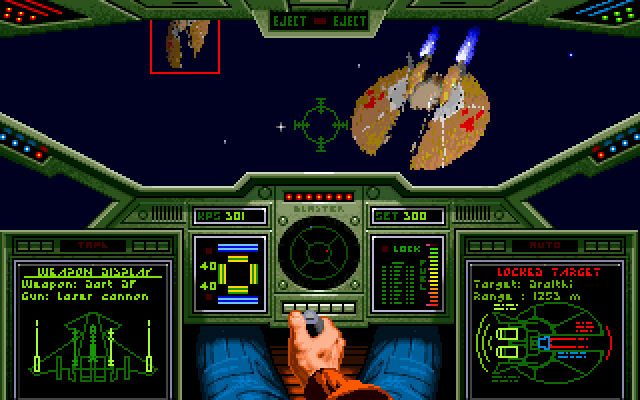
TechRadar has run an article on the evolution of video game graphics. They cover a lot of history and go into some of the tricks and trends used at different points in time. Various screenshots show how certain games have and have not aged well over the years. There is also some good conversation on the usage of three dimensions (in both 2D and 3D-accelerated environments). Wing Commander's role gets an honorable mention. Check out the whole article here.

The main reason for this was that sprites offered more detail than the polygons of the time could handle. Much like the early days, it was fine to have simple iconic shapes for spaceships and the like, which is why X-Wing's instantly recognisable ship silhouettes worked so well. However, early games didn't even have texture mapping (instead relying on simple colours and shading based on the position of the area's light source) and 3D characters were awkward-looking, low-polygon affairs.

With sprites, if you could draw it, the computer could handle it. When making Doom, id actually modelled several of its more complicated characters in clay then photographed them from multiple angles to maintain consistency.

The first Wing Commander games used a clever trick to fake space, simply moving and scaling sprites in front of the camera to add depth. It fell down when approaching capital vessels, but made for instantly recognisable ships and graphical assets that sat comfortably alongside the character portraits used in menus and cut-scenes.


--
Original update published on June 24, 2009
 
Last edited by a moderator:
That's an interesting article, I'd never really given the subject much thought. It's impressive just how seamless the Wing Commander experience is, despite the jump from point-and-click exposition to space combat or from full motion video to low-res, unaccelerated 3d spaceflight.
 
Actually the box system they used was great(although you would need a 386DX to fully enjoy it, and that was a top machine at the time, still cheaper then a Roland MT32 mind you)

The box system did allow -cheats- or abusive bugs. :)
 
They take a rather dim view of the whole FMV thing, though, commenting that most games that tried it had awful production. No mention of how WC3 and WC4 actually had very good production (or if they didn't they did a hell of a job making it look like they did).

I'm still curious why FMV died...is is just because 3D got so good that it was cheaper to animate 3D people, like in late Final Fantasy games, than it was to film real people?
 
They take a rather dim view of the whole FMV thing, though, commenting that most games that tried it had awful production. No mention of how WC3 and WC4 actually had very good production (or if they didn't they did a hell of a job making it look like they did).

I'm still curious why FMV died...is is just because 3D got so good that it was cheaper to animate 3D people, like in late Final Fantasy games, than it was to film real people?

There was a glut of insanely terrible games that had nothing but FMV to offer.

Yeah, they don't mention how the reason WC4 had such good production values (and face it: the effects and stuff don't hold up to modern movie standards when shown in high resolution) was that it was insanely expensive for the time. It cost upwards of 12 million dollars, almost all of which was just for the film shoot alone. The actual game engine was a modified version of the WC3 engine. Now imagine a game that only had a fraction of that budget, where the only actual gameplay was akin to the dialogue choices in WC3 and 4...

WC4 was successful enough to be profitable but the margins were shrinking and it scared studios as well. Development costs of AAA games today has skyrocketed since then, so that's why you see a return to it somewhat with C&C and Need for Speed, but the first thing you notice is that the scope of the sets and the FMV isn't anywhere near what WC4 had.
 
At least for me, part of the appeal of FMV games was the CD-ROM format itself. The two are so closely tied, it makes sense that their appeal would drop off as the CD-ROM itself became less and less exotic.
 
Hmmm. I think the answer goes deeper than just the costs. FMV, contrary to popular belief, was a real bargain back then - if you think WC4 was expensive, just imagine how much it would have cost had it been done as CGI. Just compare WCP with FreeSpace - both games probably had similar budgets, but one of them had over an hour (possibly closer to two hours? Never really checked) of footage, while the other had about fifteen minutes of CGI cutscenes sprinkled throughout the game. The same comparison can be made between the C&C series and Blizzard's RTSes. It's like animation versus actors in Hollywood - having a bunch of people on a stage, even if you build the sets yourself, is nowhere near as costly as drawing and animating those people frame-by-frame.

Something did start changing in the late 1990s and early 2000s. CGI started getting better *and* cheaper, once you could just render scenes in the game engine without people going "Ewww!". It's more than that, though. There's a few other factors involved...

I think I'd like to spend a bit of time researching and answering this question, even if a grand total of three people would be interested in the answer ;). Lemme think about it a bit.
 
Back
Top