Document Archive: Wing Commander III Production Book (August 11, 2013)

Bandit LOAF

Long Live the Confederation!
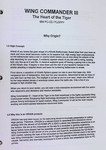
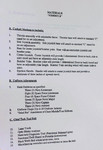
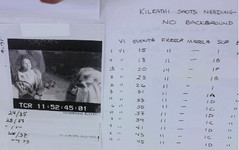
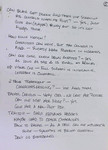
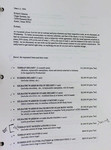
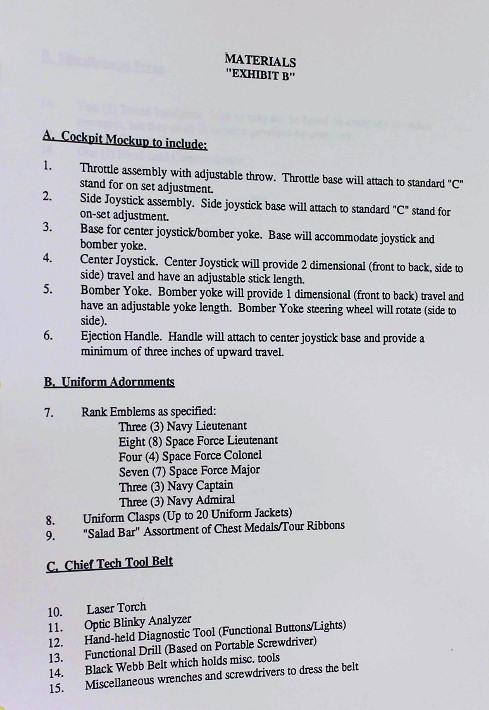
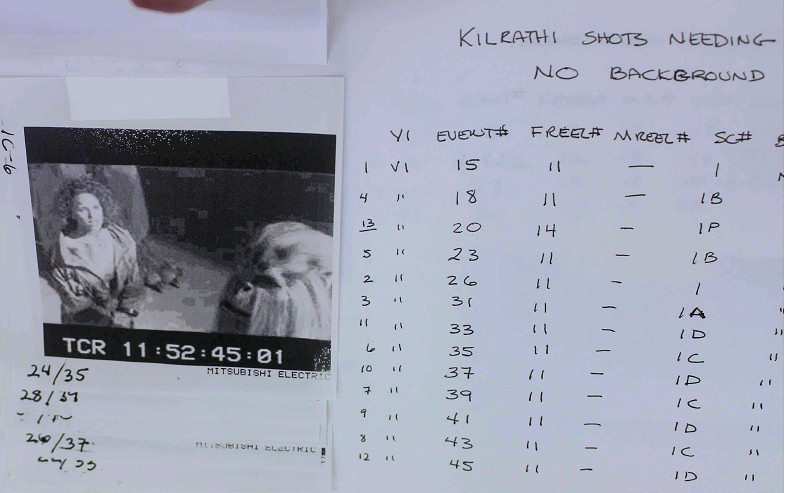
Every aspect of Wing Commander III's production is chronicled in this binder, from the set catering information to camera positions to the shooting schedule! If you're interested in the nuts and bolts of interactive movie production, this is for you.


--
Original update published on August 11, 2013
 
Last edited by a moderator:
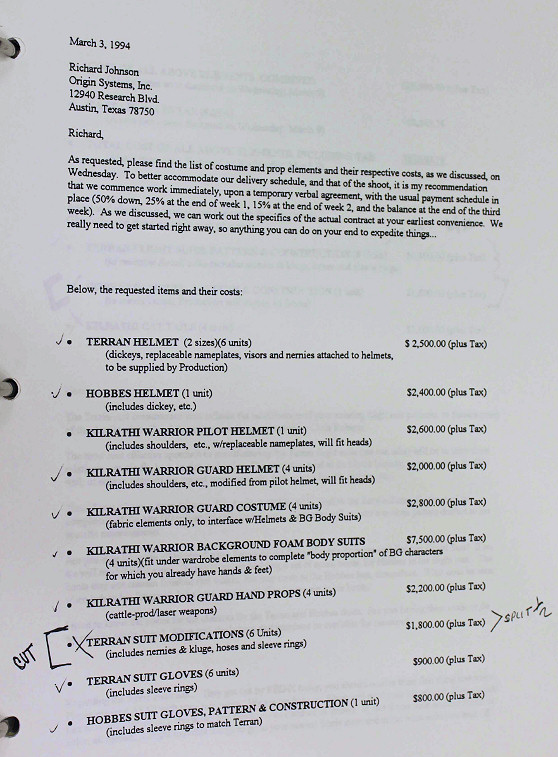
A lot of cheques and contracts and e-mails! Interesting tidbits of initial discussion regarding things like costume design as well.

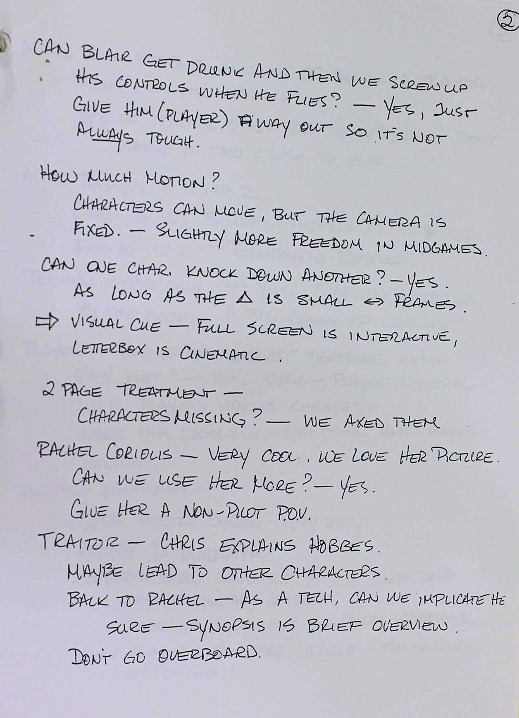
Some interesting questions/discussion with the writers starts from page 201. Page 203 shows they were aware of the possibility of too much overlap with the traitor plot in WC2. Also sounds like opinions of the initial Blair was that he was too uptight.

Page 234: They initially did some stuff with one of the kids from Home Improvement?

Page 279: Looks like they're starting to get the cast together.

Page 280: Interesting that it seems important to the potential actors as to how they're mentioned in the opening credits.

Page 331: From here to the end seems to be polaroid shots of the opening scenes.
 
Page 280: Interesting that it seems important to the potential actors as to how they're mentioned in the opening credits.

Oh, that kind of thing is crucial. Think about it - most people don't ever watch the end credits, and they simply won't know most of the actors. At best, they'll recognise someone as "the guy from Star Wars". The opening credits guarantee that someone will remember your name. They are also a status symbol, which elevates both the actor and the film - the logic being, "I never heard of this guy, but if he's highlighted in the opening credits, he must be famous".
 
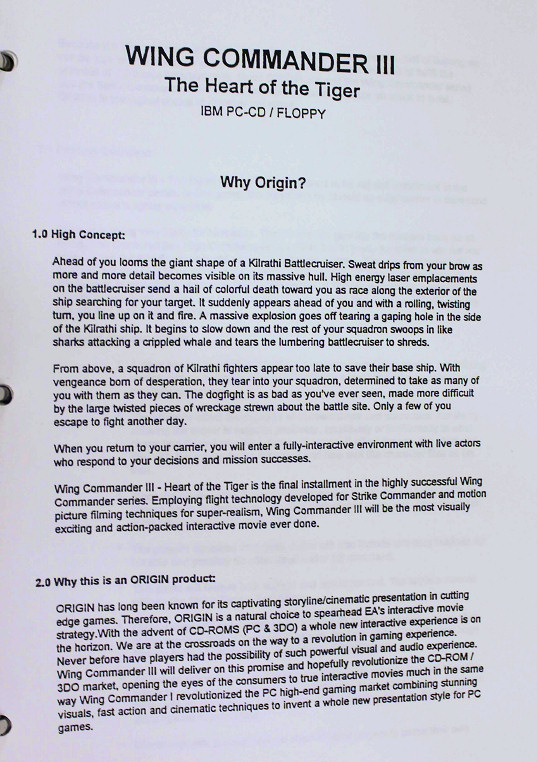
Heh. Looking through this document, the very first thing that jumps out at me is that the project timeline has the following item:

November 1, 1994 - Floppy sign-off/duplication date.

Wow. Just. Wow. And they actually talk about using low-res video in the case of the floppy version - so they were genuinely serious about it.

It makes sense from the marketing perspective, of course, given that CD-ROM market penetration wasn't that great back in 1994, but it just boggles the mind when you know that the final product shipped on four CDs (and of course, presumably at this point they may have thought it would be smaller). Even if the video resolution were halved, how many disks would the game as a whole take up? A hundred?
 
Heh......there's a math exercise for you.
Even back in the day, the average CD-ROM held a maximum of about 700 MB of data. 4 CDs then would've held approximately 2.8 GB at maximum.
The average high-density 3.5" floppy disk, IIRC, held no more than 1.44 MB of data.
Simple division...it would've taken 1,945 3.5" floppy discs to contain the equivalent amount of content, assuming each CD was packed to the gills.

Now, given a mass of about 17 grams and a volume of about 28,000 cubic milimeters per floppy (that's off the Net; take it with a grain of salt), then had they gone the floppy route:
The total mass of disks would've been 33.07 kilograms (about 73 pounds) and it would've had a volume of 1.9232 cubic feet.
Finally, assuming a cost of about $5 for a box of ten disks (and that figure's completely made up), the cost per unit would've been $972.50 - without adding a profit margin!!

Yeah..I'm pretty sure that going CD was a good choice on their part......
 
No, no, it's not quite as drastic as that.

First up, the CDs that Wing Commander III shipped on were not standard 74 minute (680 MB) discs. If I recall correctly, they were actually 60 minute discs (about 550 MB). This is actually why the holovids were removed from the PC version, and retained in the 3DO version (which did use normal 74 minute CDs).

Secondly, your maths presume that the videos would take as much space as they did on the CD. They wouldn't, because the document specifically talks about reducing their resolution. If we assume that the resolution is cut by half (to a horrifying 160x100!), the video files would take just a quarter of what they took in the CD version.

Thirdly, WC3 was designed to allow a minimum-size installation, where most of the game data was streamed off the CD. What this means is that a significant part of each of the four game CDs was taken by gameplay files - music, ships, et cetera. IIRC, you didn't have more than 400 MB of video per disc - so, theoretically, you could wind up with about 100 MB of video. Multiply this by four, add the gameplay files, and you wind up with a grand total of about 550 MB, or 382 1.44 MB floppy disks.

But wait, there's more! The data on the CD was mostly uncompressed - some compression of the video was used, of course, but generally, everything was kept as uncompressed as possible, so that the game would not waste time decompressing data when reading off the excruciatingly slow 1x CD-ROM drives. Naturally, when a game is released on floopies, everything is compressed as much as possible to minimise the number of disks. And Origin was the absolute expert in minimising install package sizes - they had to be, because games like Strike Commander were pretty darn big.

All in all, I think they could have ended up reducing the game's overall size to about 200 floppies. Maybe even less. Still utterly impossible for profitable publishing ("well, I can pay $250 for this game... or I can buy a $200 CD-ROM and pay $50 for the game... hmm..."), but at least it's a package size that's within the realm of the imaginable - with 17 grams per floppy, we're only talking about a 3.5 kg total box weight :D.

However, there remains one tiny, irksome issue to all this - who on Earth would have had a hard drive big enough to install a 550 MB game in 1994?!
 
I remember talking with my high-school friends about how crazy it was that it was a four-CD release, thinking initially that it would only be two CDs. I missed the mention of reducing resolution, but the number of floppies would still have been infeasibly huge. Remembering how Origin had to hock itself to EA because of not having the cash to pay for enough floppies for distribution, I'm glad they didn't go through with this option.

Oh, that kind of thing is crucial. Think about it - most people don't ever watch the end credits, and they simply won't know most of the actors. At best, they'll recognise someone as "the guy from Star Wars". The opening credits guarantee that someone will remember your name. They are also a status symbol, which elevates both the actor and the film - the logic being, "I never heard of this guy, but if he's highlighted in the opening credits, he must be famous".
I realise that, of course. Just at the time I was reading it, it almost felt like a bunch of squabbling kids fighting for your attention. Obviously I misread the intention - contract negotiations aren't really familiar to me (not that I want it to be).

Even today, I still think it's awesome that Origin/EA picked up four recognisable actors to really stand out in that FMV-saturated era. How they were ultimately credited in the opening scenes, I don't recall, other than Hamill had first billing and McDowell was specifically cited as 'Tolwyn'.
 
I remember talking with my high-school friends about how crazy it was that it was a four-CD release, thinking initially that it would only be two CDs. I missed the mention of reducing resolution, but the number of floppies would still have been infeasibly huge. Remembering how Origin had to hock itself to EA because of not having the cash to pay for enough floppies for distribution, I'm glad they didn't go through with this option.
Yeah, floppy distribution really cut into the profit margins back then. Of course, boxed distribution in general is simply more expensive, and in the case of Origin in particular, you have to take into account all the extra work they always put into the manuals, maps, et cetera. Origin's games would have been amongst the most expensive to distribute in those days. Ironic, isn't it, that all that extra effort resulted in lower profit margins for the company as a whole?

I realise that, of course. Just at the time I was reading it, it almost felt like a bunch of squabbling kids fighting for your attention. Obviously I misread the intention - contract negotiations aren't really familiar to me (not that I want it to be).
Yeah, and this is one of the reasons why most actors, film directors and writers employ agents: in any negotiations, at least one side (sometimes both) is represented by an agent. This way, any bad blood that arises during negotiations will always fall on the agent, while the actor will be able to start the project on a clean slate. Some folks think that if they're smart enough to understand all the legalese language, they can do without an agent - but what they find is that ultimately, either they'll be disliked by their employer (what a jerk, he spent five hours bickering over opening credits!"), or they'll drop important contract terms in the interest of maintaining goodwill.

Even today, I still think it's awesome that Origin/EA picked up four recognisable actors to really stand out in that FMV-saturated era. How they were ultimately credited in the opening scenes, I don't recall, other than Hamill had first billing and McDowell was specifically cited as 'Tolwyn'.

I'm not sure if there's any special reason for this, but it's pretty frequent for the last actor in the opening credits to be billed with the name of his character - we even did the same in Standoff :). In our case, it was a way of highlighting a small but important role (Sparrow in the first episode, and then Reismann in the rest of the series). It may be that this is how it usually works - at least, it seems like very often these last-billed roles are the likes of Tolwyn: a high-profile actor is cast as a character who has limited screentime but is particularly significant to the story.

...Either that, or it's simply a way of making clear to the audience that this is the last actor name in the list :).
 
Part of what made Origin stand out was the extra stuff that came with the box. In our current environment where download-only distribution is fairly common, you just don't get that nice bonus any more. Even if you have extras as additional downloads (such as with Origin stuff on GOG), sometimes it's just nicer to have a proper print-out.

I think the '[famous actor] as [limited screen-time but significant character]' final billing is a fairly common convention even in movies I see at the cinemas.
 
Back
Top