We Chose To Go To The Moon (July 20, 2012)

Dundradal

Frog Blast the Vent Core!
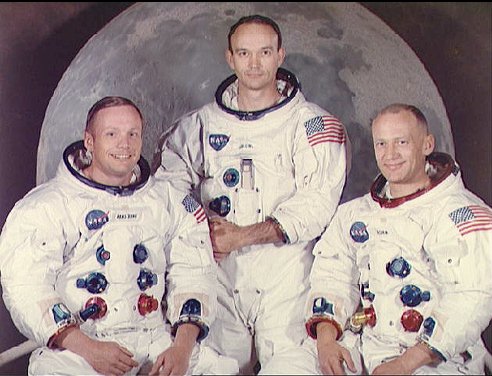
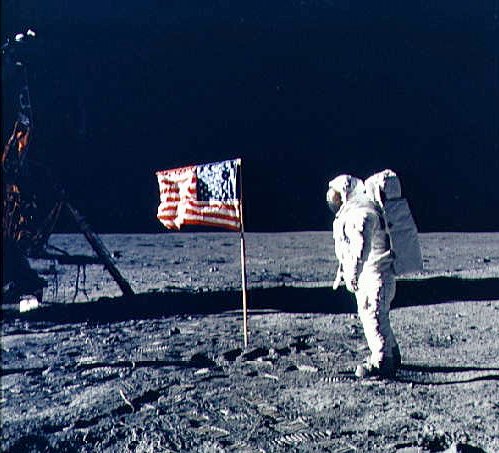
Today is the 43rd anniversary of the human race first landing on the Moon. Apollo 11 astronauts Neil Armstrong and Buzz Aldrin descended to the lunar surface in the Lunar Excursion Module while Michael Collins remained in orbit in the Command Module.

Wing Commander has a number of important lunar installations. Moonbase Tycho, the Vacuum Breathers bar, an anti-matter/matter production facility and a massive naval base, much of which was destroyed during the Earth Defense Campaign of 2668.




--
Original update published on July 20, 2012
 
Last edited by a moderator:
The sad thing is that I'm not sure we could get back there today. At least, not easily. We've lost a lot of the technology.

Manned space travel is one of the few technologies that we've taken a step backwards in the last 30 years.
 
The sad thing is that I'm not sure we could get back there today. At least, not easily. We've lost a lot of the technology.

Manned space travel is one of the few technologies that we've taken a step backwards in the last 30 years.

I don't think the technology is lost. Certainly there aren't any systems in place or the will to spend the money to go back in the short term. Any return to the moon would be years off require everything built from the ground up. But certainly the know-how isn't lost.
 
The sad thing is that I'm not sure we could get back there today. At least, not easily. We've lost a lot of the technology.
We didn't lose the technology, we just abandoned it as useless and obsolete. Why use a processor less powerful than a modern mobile phone, for example? I am pretty sure that if someone actually wanted to provide the money, any large aircraft manufacturer could come up with a preliminary design within a couple of days, and actually get to work on producing the spacecraft within weeks of the initial announcement, completing a prototype within several months. It's... not exactly rocket science :p.
 
Not if it's a contract for NASA--the bureaucratic requirements slow everything down, since each step of development has to be inspected and signed off by them before the next step can begin. Now, if Boeing or Lockheed were to devote sufficient manpower and budget to it and didn't have to answer to anybody besides the FAA on the development, then they might get something ready for actual launch testing within a two-year time frame.
 
Well, sure, NASA would slow it down - but NASA is not mankind, nor is it even the United States :).

I must admit, I was almost certain that as soon as someone collected the X-Prize, a new prize would be offered for the first private spacecraft to return from the Moon. But I guess it's a bit too big a leap, and first they need to really commercialise orbital flights.
 
Not if it's a contract for NASA--the bureaucratic requirements slow everything down, since each step of development has to be inspected and signed off by them before the next step can begin. Now, if Boeing or Lockheed were to devote sufficient manpower and budget to it and didn't have to answer to anybody besides the FAA on the development, then they might get something ready for actual launch testing within a two-year time frame.

Having actually worked on big, multi-million dollar projects with both Lockheed and Boeing, I can attest that their bureaucratic and contract requirements are every bit as onerous as the U.S. governments, and in some case more so (big companies' IP lawyers and lawyers worried about liability generally slow a lot of things down a lot, which are issues that government agencies typically worry less about. They also are constantly in threat of being shut down if the CEO's decide something might not be profitable, which is also something that government programs don't worry about). If you're looking to private companies to get us to the moon, you're probably better off going with a small, agile, and well-funded company (like SpaceX).

What I meant when I said we've lost the technology is just that. (1) We no longer, as a nation, have the industrial capacity to build a lift vehicle like the Saturn V. We simply do not have infrastructure for building something that big and powerful, without some re-investment of R&D into large scale processing and manufacture. (2) We no longer have all the models that were used to develop the moon spacecraft, and we no longer have a lot of the data needed to validate new models that we might develop. Conducting the experiments to get that validation data, or developing sophisticated enough detailed computer models to work in lieu of having data for validation (a chancy proposition at best), takes quite a bit of time and money. (3) Safety standards are much higher today than they were in the 1960's, and tolerance for failure is much lower. Hence even the old technology wouldn't be considered viable today. Engineering everything to higher safety and reliability standards is very very challenging. (4) We don't even have a lot of the know-how left. The scientists and engineers that worked developed Apollo would have been in their 30's and 40's, if not older, in the mid-1960's. The ones that merely "worked on" Apollo would have been as old in the mid-1970's. It's now 40 years later. Even the young guys who worked on Apollo at the very tail end of its run would now be in their mid-70's and have retired by now. There's no substitute for hands on experience in developing a project like that. At best we have old guys that once worked with older guys who might have worked on Apollo when they were young. And given the spotty funding of the space program for the last twenty or so years, our best current guys, young and old, have been all going into other fields of science completely (if they go into science or engineering at all...don't get me started on how bright young people are incentivized to become bankers or stockbrokers rather than engineers or teachers, to the detriment of society).
 
Now, if Boeing or Lockheed were to devote sufficient manpower and budget to it and didn't have to answer to anybody besides the FAA on the development, then they might get something ready for actual launch testing within a two-year time frame.

If you want to build rockets in the US, you don't just have to comply with the FAA - there are also International Traffic in Arms Regulations. If you can put a satellite into orbit, you can drop a bomb on the city of your choice. The reverse also holds - Sergei Korolev and Wernher von Braun both got in trouble for trying to reach the moon when they were supposed to be making ballistic missiles.

You don't even have to be building the rockets - talking to other people about their rockets is bad too. The Planetary Society built a solar sail experiment called Cosomos-1. The launcher - a Russian-made Volna rocket - failed. The team were warned that they would need permission from the US State Department if they wanted to contribute to the launch failure review.

Military money has paid a lot of the bills for launcher and satellite development, so civilian aerospace wouldn't be where it is today without those military applications. However, they can also be a pain, especially if you'd like to see more space exploration. At least we have MESSENGER, Venus Express, Opportunity, Curiosity, Rosetta, Chang'e 2, Cassini, New Horizons and both Voyagers.
 
Back
Top