WC vs History - Don't Give Up The Ship! Fight Her Till She Sinks. (June 22, 2012)

Dundradal

Frog Blast the Vent Core!
Today marks the 205th anniversary of the Chesapeake-Leopard Affair of 1807. An event that greatly angered Americans and was one of the many factors that led to the declaration of war against the British in June 1812. Today?s WC vs. History focuses on the first of the ships involved, the USS Chesapeake and its story and spot in Wing Commander lore.

The War of 1812 began on 18 June 1812 when the United States declared war on England for a number of reasons including impressments of American sailors and interfering with American free trade with France. This month marks the start of bicentennial anniversaries for the war?s many engagements. Wing Commander has only one direct reference to the conflict, besides several ship names, and it comes from Admiral Tolwyn in Fleet Action:

"There was an ancient cautionary tale told in the service academies, the incident dating back to a war once fought between England and America. In an encounter between an American and British ship the commanding officer of the American vessel was mortally wounded, and the junior officer took him down below deck to the surgeon. In the short interval that followed all the other officers were hit and, without his even being aware of it, the junior officer was now in command. By the time he returned to the deck his ship had already been battered into submission and forced to surrender after barely putting up a fight. The junior officer was held responsible, court-martialed, and found guilty of dereliction of duty, a duty he was not even aware had suddenly come to rest upon his shoulders. The lesson was part of the tradition and backbone of the fleet - there is no excuse for defeat."

The battle Tolwyn was referencing was between the USS Chesapeake and HMS Shannon on 1 June 1813, 20 miles off Boston, Massachusetts. USS Chesapeake was one of the six frigates ordered by the Naval Act of 1794. These were the original six warships of the United States Navy. What made the Americans frigates effective was there speed and firepower. Armed with 38 guns, the frigates could engage most ships with an advantage. Those ships or battles it could not win through firepower, it could flee with its greater speed. The story of the USS Constitution fleeing a British squadron, through the use of rowboats in front and dropping out the anchor and reeling it in, is one of the most impressive escapes in naval history. Chesapeake was to have a less illustrious history.
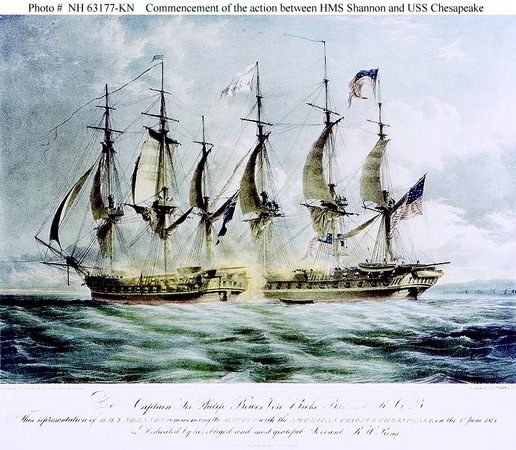


Read the rest of this article in the archive here.

--
Original update published on June 22, 2012
 
Last edited by a moderator:
An excellent (somewhat fictionalised, though entirely based on historical documentation - "It seems to me that where the Royal Navy and indeed the infant United States Navy are concerned there is very little point in trying to improve the record, since the plain, unadorned facts speak for themselves with the emphasis of a broadside; and the only liberty I have taken is to place my heroes aboard") of the Shannon-Cheasapeake engagement, from the British perspective, can be found in Patrick O'Brian's novel The Fortune of War.
 
An excellent (somewhat fictionalised, though entirely based on historical documentation - "It seems to me that where the Royal Navy and indeed the infant United States Navy are concerned there is very little point in trying to improve the record, since the plain, unadorned facts speak for themselves with the emphasis of a broadside; and the only liberty I have taken is to place my heroes aboard") of the Shannon-Cheasapeake engagement, from the British perspective, can be found in Patrick O'Brian's novel The Fortune of War.
Speaking of which, can anyone point me to some personal memoirs (doesn't matter from which side) from this period? And by "this period" I mean from the War for Independence all the way through to the end of the War for Southern Independence. I have a pretty nice collection of personal memoirs from WWI and WWII (oddly enough, the lion's share of them are u-boot commanders... I'm not sure if they wrote unproportionally more than others, or if they're simply more popular in publishing), but nothing from before the 20th century.
 
I don't know of any specific ones I could list off the top of my head, but there's got to be lots. For the Civil War, at least, you could probably start with any of the numerous non-fiction books that have been written about it, and look at their citation list. The ones I have read very frequently excerpt personal memoirs and letters, etc.

I also haven't really heard the term "War for Southern Independence" much. In general, in the U.S. most people refer to it as the "Civil War", except in the deep south, where it is often called the "War between the States". I guess I have heard the phrase "War for Southern Independence", but it's very uncommon (and has a very strong pro-Southern tilt).
 
Speaking of which, can anyone point me to some personal memoirs (doesn't matter from which side) from this period? And by "this period" I mean from the War for Independence all the way through to the end of the War for Southern Independence. I have a pretty nice collection of personal memoirs from WWI and WWII (oddly enough, the lion's share of them are u-boot commanders... I'm not sure if they wrote unproportionally more than others, or if they're simply more popular in publishing), but nothing from before the 20th century.

Civil War memoirs are difficult because there are SO many of them. Unlike a lot of wars, it was very much romanticized in its own time and by its participants... and that lead to a huge market for diaries and memoirs in the 1880s-1890s. And that glut never really filtered down, so today most discussions are about what the best some-specific-role book is (what sharpshooter wrote the best book, what cavalaryman, etc.)

Unquestionably, 'the' memoir is Mary Chesnut's Civil War. It's not a battle history, but a very well (and famous) view of the Confederacy's rise and fall at home. In terms of military memoirs, a reasonable place to start might be with the two books that the famous Ken Burns Civil War documentary was based on (one for each side): All for the Union (Elisha Hunt Rhodes) and Company Aytch (Sam Watkins.)

A few good memoirs/collections of letters: Gone for Soldier (Alfred Bellard), Rebel Private (William Fletcher), Soldiering (Rice Bull), Hard Marching Every Day (Wilbur Fisk), Inside the Army of the Potomac (Francis Donaldson.) One thing that will disappoint you (as I suppose it does in every war, but more so here) is books by anyone especially important. It wasn't proper for great men to speak much about themselves at the time and so memoirs for people like Grant and Sherman tend to be very dry, literal histories.

I also haven't really heard the term "War for Southern Independence" much. In general, in the U.S. most people refer to it as the "Civil War", except in the deep south, where it is often called the "War between the States". I guess I have heard the phrase "War for Southern Independence", but it's very uncommon (and has a very strong pro-Southern tilt).

"War for Southern Independence" was a contemporary term. The Confederacy was initially very interested in selling the war as spiritual successor to the American Revolution (you know, the Bjoshock of wars.) So you'll find all sorts of allusions to Lexington and Concord when you're reading Confederate accounts of those early battles. It had faded away from the public consciousness by the end of the war. It has been brought back today, but really only in an obnoxious assosciated-with-white-supremacy sense.
 
Don't hear that one very often around here.
Hehe, yeah. I kinda used it just to be contrary (but also because it sounded nice - from one war of independence to another). That having been said, it's actually very close to the term that's normally used in Poland (and a lot of non-English language Europe, apparently): the Secession War.

(various books)
Thanks for the information you posted, that sounds like a great start! One thing I forgot to mention, though, is that I'm especially interested in naval memoirs. I figure that especially amongst the Confederates, there must be some pretty interesting ones, what with all the blockade running and the like.

(I'd also be interested in naval memoirs for the Spanish-American War, but there's probably not too many of those around - it wasn't that romantic)

One thing that will disappoint you (as I suppose it does in every war, but more so here) is books by anyone especially important. It wasn't proper for great men to speak much about themselves at the time and so memoirs for people like Grant and Sherman tend to be very dry, literal histories.
Actually, that's exactly the kind of thing I'm interested in. Amongst the books that I do have (as I said, mostly WWI and WWII), I find that books written by great men tend to be the least interesting no matter how honest they get. Books written by privates tend to be the most exciting (because they were closest to the fighting). Books written by small unit commanders tend to be great lessons in leadership, which actually can be applied in real life situations. And books written by great men... well, they're really just slightly more personalised history lessons.
 
I can't really help you with the Americans so much, but there's a few British officers of that period who wrote memoirs. Actually, British naval officers seem to have been great writers in general, but most of them tended to stick to letters rather than full memoirs. Some of the more notable officers, such as Collingwood and Broke, had selections of their letters published by children or grandchildren, but I've never really looked into those. There were at least three partial memoirs from the late age of sail, though - I think all of these are available at Project Gutenberg (their authors having been dead for over a hundred years).

Thomas Cochrane wrote extensively about his activities in the Latin American Wars of Independence, though one would never accuse him of literature. (On the other hand, I am now aware of why it is that PG Wodehouse wrote of "a Scotsman with a grievance" to describe somebody who was particularly upset.)

William Bligh wrote about the mutiny on HMS Bounty and the subsequent and preceding events of the voyage; his style is rather less personalised than Cochrane's, fortunately.

Robert Fitzroy wrote about the surveying voyages he undertook with HMS Beagle and HMS Adventure, which are probably of more interest to historians of science than anybody primarily interesting in the steam-and-sails period, but are fairly well-preserved due to their association with Darwin.
 
Thanks for the information you posted, that sounds like a great start! One thing I forgot to mention, though, is that I'm especially interested in naval memoirs. I figure that especially amongst the Confederates, there must be some pretty interesting ones, what with all the blockade running and the like.

Naval memoirs are a lot harder to come by. That aspect of the war was not popularized in its time. Check out Memoirs of Service Afloat During the War Between the States by Raphael Semmes, though, which may fit your bill. Semmes commanded a Confederate raider (and his book is considered one of the best defenses of the Confederate cause.)
 
I can't really help you with the Americans so much, but there's a few British officers of that period who wrote memoirs. Actually, British naval officers seem to have been great writers in general, but most of them tended to stick to letters rather than full memoirs. Some of the more notable officers, such as Collingwood and Broke, had selections of their letters published by children or grandchildren, but I've never really looked into those. There were at least three partial memoirs from the late age of sail, though - I think all of these are available at Project Gutenberg (their authors having been dead for over a hundred years).
Neat, I'll look into those as well at some point. They're slightly different to what I'm interested in, so they'll probably wait a bit, though.

Naval memoirs are a lot harder to come by. That aspect of the war was not popularized in its time. Check out Memoirs of Service Afloat During the War Between the States by Raphael Semmes, though, which may fit your bill. Semmes commanded a Confederate raider (and his book is considered one of the best defenses of the Confederate cause.)
That's exactly the kind of book I'm looking for! And it was pretty easy to find a digital copy as well! Thanks!
 
Back
Top